Carson Wood Flooring brings more than 20 years of wood-flooring work to Artesia, and every job here starts with the same question: what is already under the floor, and how dry is it? Installation, board repair, sanding and refinishing all go better when the subfloor and the moisture picture are known before anyone writes a price.
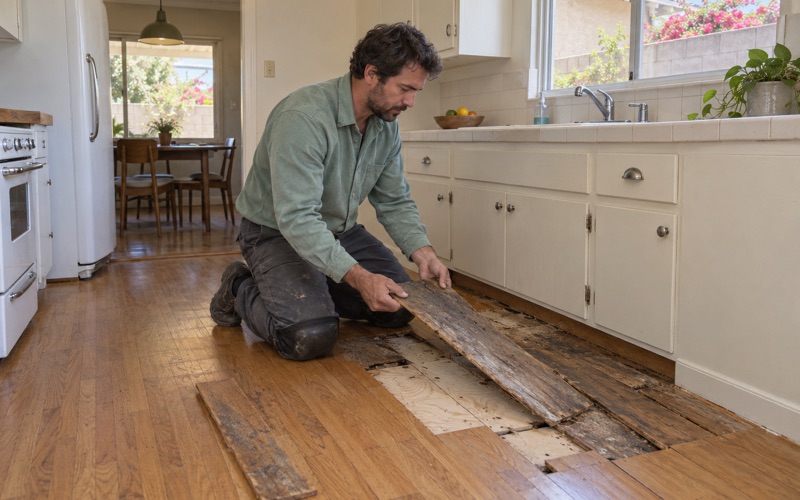
So we open the floor and look at the decking before we quote a finish floor. A soft spot, a water-swollen panel or a tired joist shows up on the estimate instead of turning into a callback three months after the job. Moisture readings in the wood, and in any concrete a room sits on, are taken and written down before a single carton is ordered.
Once the material arrives, it sits in the rooms it will live in. We log its moisture content on arrival and again right before installation, so the decision to start is based on numbers rather than a calendar. The reasons that routine matters in this city go back to its name, to a soil study done a few years ago, and to houses that have been standing for decades.
Artesia’s Name and the Water Beneath It
Most cities get their names from a founder or a landmark. This one got its name from what was underground, and that history is a useful starting point for anyone planning floor work here.
Named for Flowing Wells
Artesia was named for the many flowing artesian wells in the area, which made the land well suited to farming. Dairymen, mainly of Portuguese ancestry, came down from the San Joaquin Valley in the early 1920s, and Dutch dairy families settled here in the same decade. After World War II, developers pressed for residential tracts, and the dairies moved out to Chino and the Central Valley.
The city incorporated on May 29, 1959, covering just 1.62 square miles. Those wells belong to the town’s farming past, not its present. What the name does is remind us that water shaped this ground long before the houses went up, which is reason enough to measure rather than assume.
What a 2022 Soil Study Found
In May 2022, Leighton Consulting prepared a geotechnical exploration report for a water reservoir and booster pump station at 17456 South Roseton Avenue. The crew encountered groundwater at depths of 26 and 29 feet below the existing grade. Under a thin layer of man-made fill, up to 5 1/2 feet thick, the site sits on alluvial fan deposits of sandy silt and stiff silty clay with layers of sand and silty sand.
The report did not stop at the water it found. Its analysis also used a historically high groundwater level of 10 feet deep. It cites the California Geological Survey’s 1998 Seismic Hazard Zone Report for the Los Alamitos Quadrangle, which places that site within an area identified as potentially susceptible to liquefaction, and it notes the site is not within an Alquist-Priolo fault zone.
One Site, Not Every Street
That study describes one property on one street. It does not tell anyone how deep the water sits beneath a particular home, and we will not pretend it does. What it does tell us is that engineers working here did not assume the ground was dry, and neither do we, so a dry-looking room is something we confirm with a meter.
Looking for wood-flooring closer to Hawaiian Gardens? See Wood-Flooring in Hawaiian Gardens.
Checking for Moisture Before a Wood Floor Goes In
Wood takes on and gives up moisture until it matches its surroundings. A floor installed before that balance is reached will move afterward, and the movement shows up as cupping, crowning, board gaps or, in the worst cases, buckling. Measuring first is cheaper than tearing out a floor later.
Reading the Wood
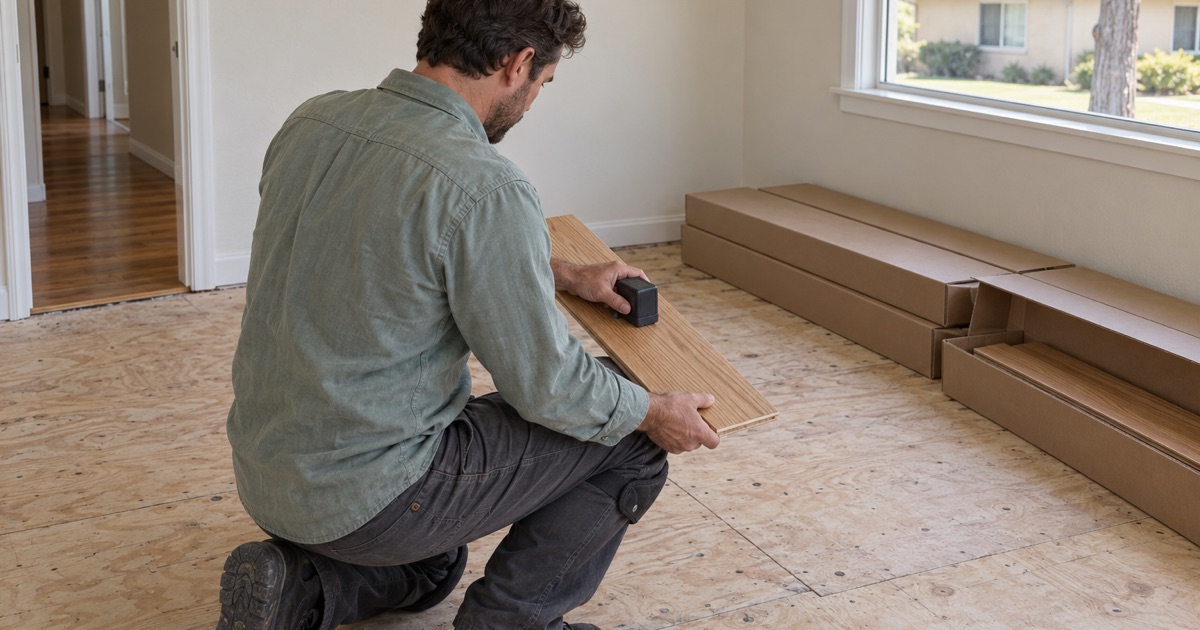
Every delivery gets checked with a wood moisture meter, and we compare those readings against the subfloor underneath. The NWFA installation guidelines treat that comparison as the heart of acclimation, and we follow them. If the numbers are too far apart, the boards wait until they close the gap.
Artesia falls in the National Weather Service forecast zone CAZ368, Los Angeles County Inland Coast. That tells us conditions indoors can shift with the seasons, so acclimation is judged by readings on the day rather than a fixed number of days. The readings go into the job file, and you get a copy.
Testing Concrete Where There Is Any
When a room sits on concrete, the concrete gets its own tests. An ASTM F2170 in-situ relative humidity test measures moisture from inside the slab, and a calcium chloride moisture test reads what is coming off its surface. We decide on a vapor retarder based on those results, never on a guess about how the house was built.
Choosing an Installation Method From the Readings
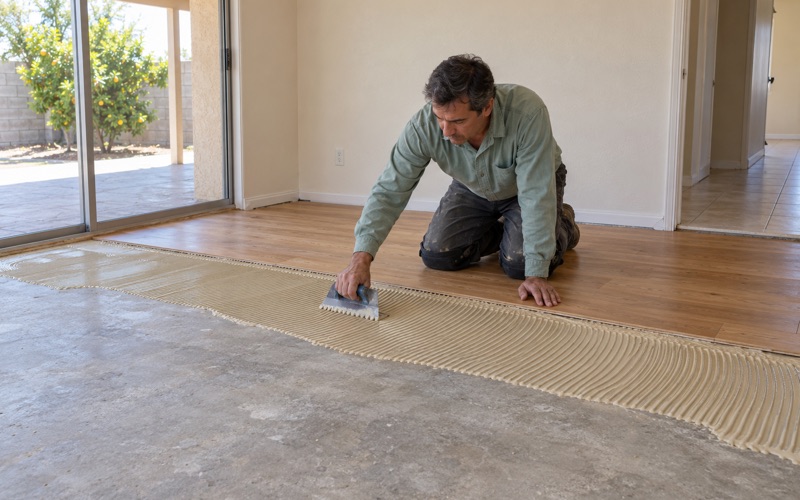
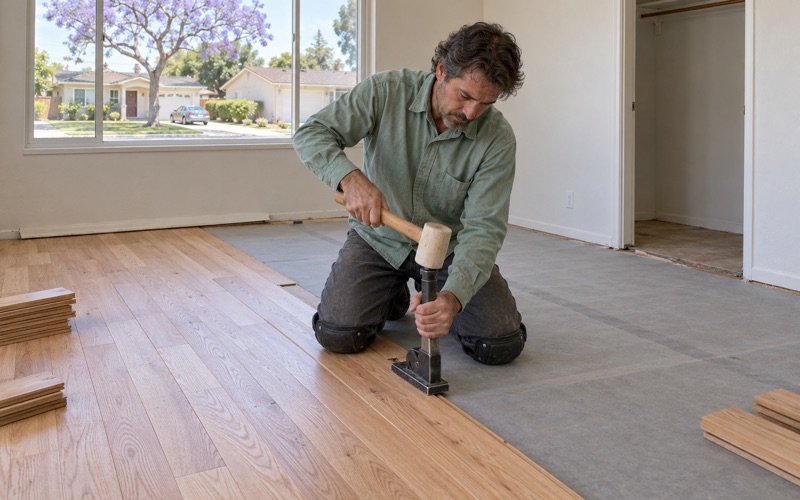
The numbers help decide how the floor goes down. Solid boards over wood decking are usually a nail-down installation with a cleat nail or flooring staple, while engineered core construction opens up glue-down and floating installation over concrete. A thicker wear layer buys more future sanding, which matters in a house you plan to keep.
What the Readings Mean for Your Schedule
Most of the time, the readings come back where they should and the job moves ahead on the planned dates. When they do not, we would rather tell you on day one than explain a gapped floor next winter. A delay of a few days while boards settle in is a small cost next to a reinstall.
If the concrete or decking reads wet, the next step is finding out why. That might mean a plumbing leak, a grading problem outside a wall or an old repair that never dried out. We note what we see, share the numbers and help you decide whether to fix the source first or change the flooring plan.
What Sits Under the Floor in an Older House
About 76.2 percent of Artesia’s housing was built before 1980. Floors in houses that age have usually been covered, patched and recovered more than once, and the layers tell us a lot before the new floor is chosen.
Decking, Joists and Settling
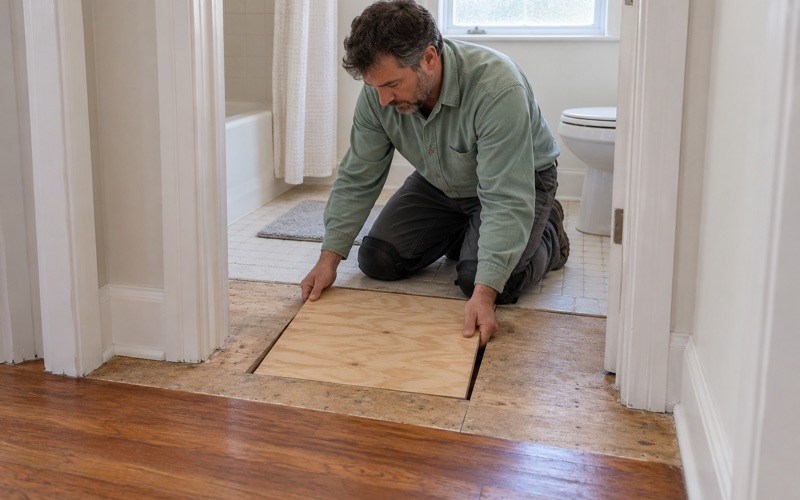
We pull a section of the old covering and check the floor decking for soft spots, water staining and swelling. Squeaks and sloping floors point us to the framing, where a cracked or sagging floor joist may need joist sistering before anything goes on top. Worn decking often gets new plywood underlayment so the finish floor has a flat, firm base.
Settling has several possible causes, and we do not diagnose ground conditions from inside a living room. What we can do is show you where the floor is out of level, what the framing looks like and what a repair involves. If the problem looks structural rather than cosmetic, we say so plainly before pricing any finish floor.
We also look for signs of drywood termites and powderpost beetles while the decking is exposed. Kick-out holes and piles of termite frass along a wall are easy to miss under carpet and hard to ignore once the covering is up. Treating damaged wood before the new floor goes down keeps the problem from spreading into it.
Old Tile and Black Mastic
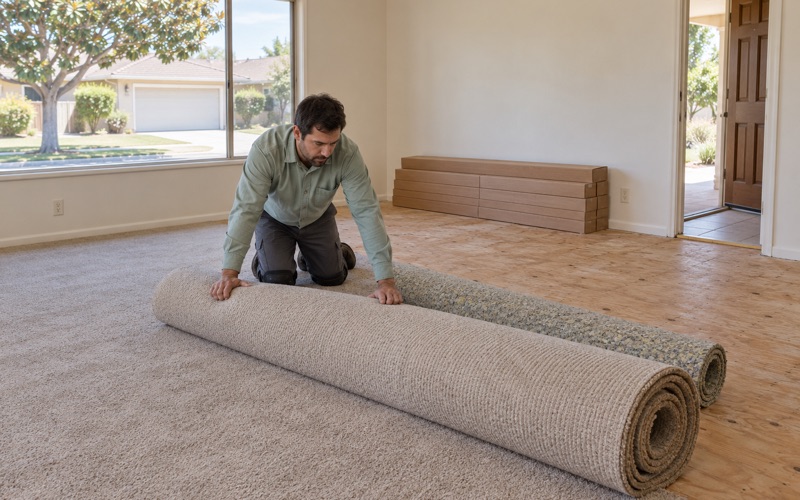
Older houses sometimes hide 9x9 asbestos floor tile or black mastic under carpet or sheet vinyl. We treat either one as a possible asbestos question and stop before sanding, grinding or scraping. An asbestos survey settles it, and South Coast AQMD Rule 1403 governs how confirmed material is handled.
Lead-Safe Work on Pre-1978 Houses
Any house built before 1978 may carry lead paint on baseboards, trim and thresholds, all of which get disturbed during floor work. We follow the EPA Renovation, Repair and Painting rule on pre-1978 housing, with containment and cleanup to match. Shoe molding and trim come off carefully so dust stays where it can be controlled.
Planning Floor Work in Artesia
Once the subfloor and moisture questions are answered, the rest of the job is about choices: species, finish, schedule and paperwork. We walk through each one with you before work starts.
Species and Finish
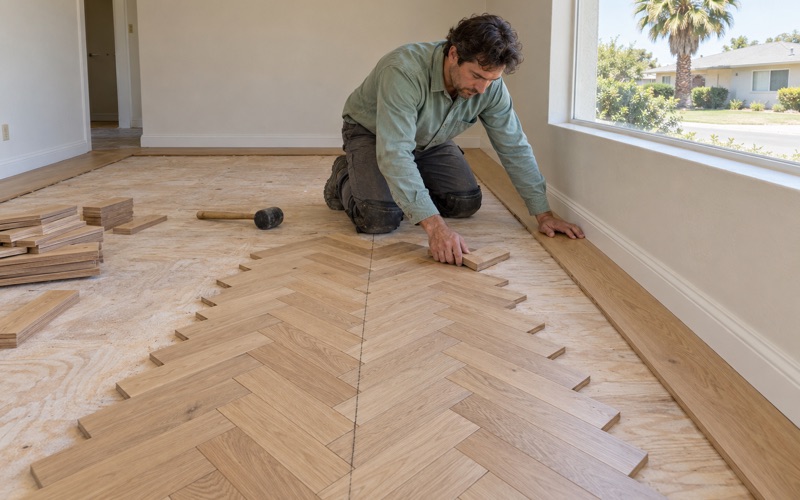
White oak, red oak, hickory, maple and walnut each have a Janka hardness rating that tells you how well they resist dents. Hickory and maple stand up to heavy traffic, while walnut is softer and shows wear sooner. Wide plank boards and herringbone or chevron patterns change both the look and the labor.
Artesia is in the South Coast Air Quality Management District, so every finish we apply meets SCAQMD Rule 1113 and its wood coatings VOC limit of 275 g/L. That still leaves real options: waterborne polyurethane, oil-modified polyurethane and hardwax oil finish all come in several sheen levels. We will show you samples on your own boards before choosing.
Refinishing, Repairs and Stairs
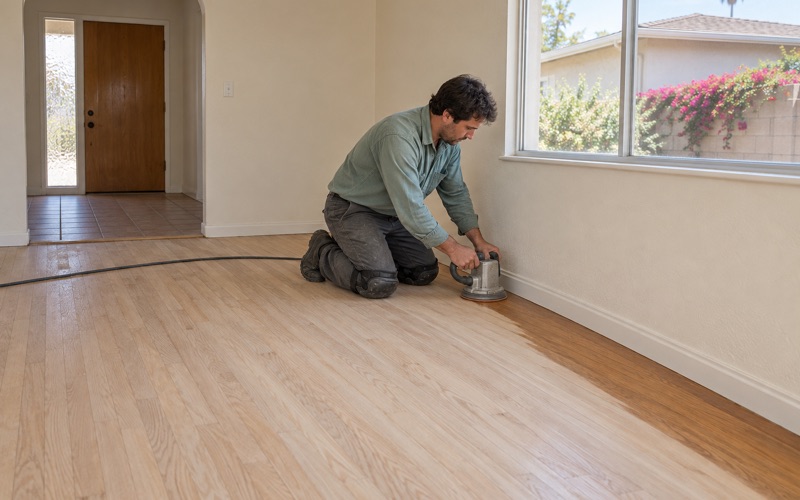
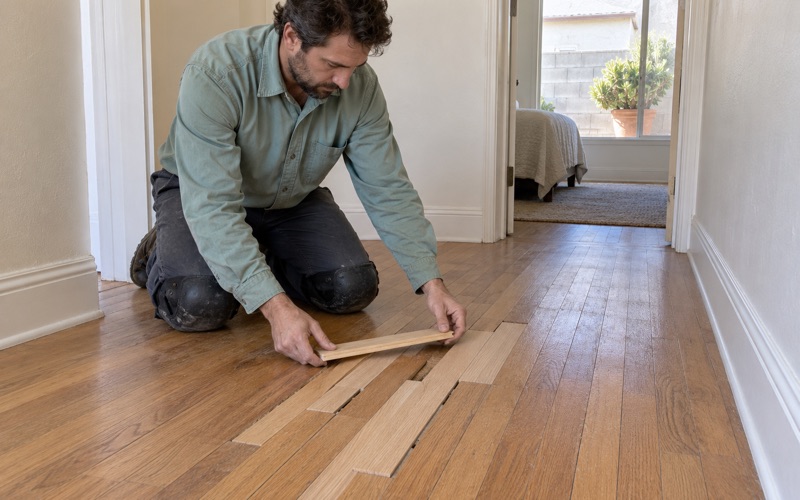
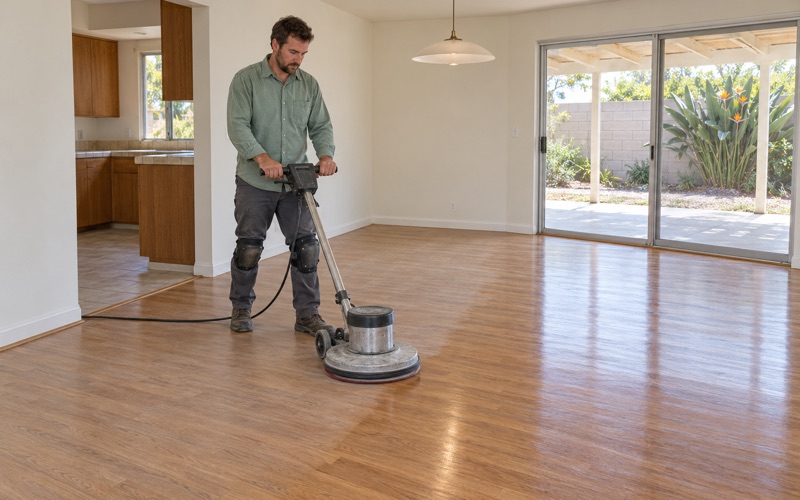
Not every floor needs replacement. A screen and recoat can refresh a sound finish, while peeling polyurethane, blotchy stain or pet urine stains usually call for a full sanding with a drum sander, edger and orbital sander through a proper grit sequence. Damaged boards can be fixed with board replacement and a weave-in repair so the patch disappears into the floor.
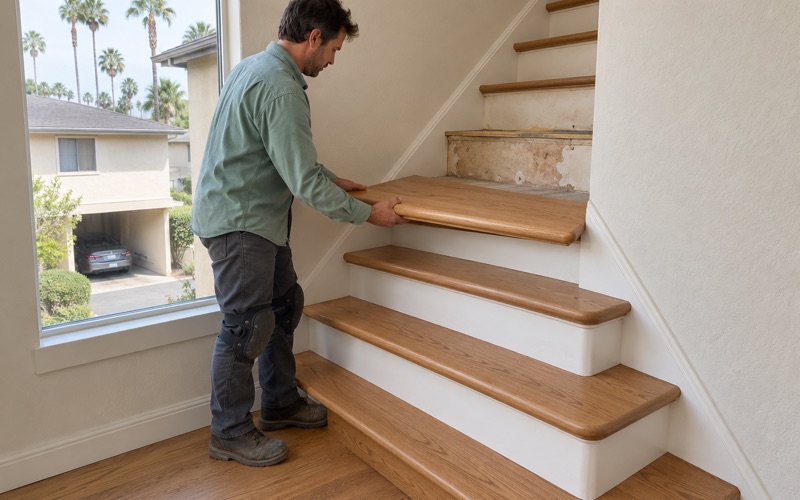
Stairs are priced per stair tread and stair riser, with stair nosing, reducer strips and T-molding listed separately. That keeps the estimate honest when a staircase is part of the job. You can see exactly where the money goes.
Water Damage, Dust and Scheduling
When a floor has water damage, we trace it to the source first and document the damage with photos and moisture readings an insurance adjuster can use. Replacing boards without stopping the leak just repeats the loss. The report stays with you for the claim.
In an occupied home, we set up dust containment and use a dustless sanding system wherever the floor allows. You get a written cure schedule showing when each room can be walked on and when furniture can go back. Estimates and invoices are itemized in writing, so every line of the work is on record.
City Contacts
Questions about city requirements for a project go to City of Artesia Building & Safety at 18747 Clarkdale Avenue, whose services are provided under contract by BPR Consultants. We recommend checking with that office early, before material is ordered. Then the floor can go in on a schedule built around real readings from your own house.
- 20+ Years on Wood Floors
- Moisture Readings in Writing
- Air-Basin-Compliant Finishes