
Carson Wood Flooring carries out hardwood floor repair in Carson, CA, serving surrounding cities including West Carson, Compton, Wilmington, West Rancho Dominguez, East Rancho Dominguez. In more than 20 years on wood floors, we have found that most damaged floors need a targeted repair rather than a new floor, and that the skill is in making that repair invisible.
Repair covers everything from a single split board by the back door to a hallway that squeaks from end to end. It also covers the damage that older houses collect: pet stains from a previous owner, drywood termite holes, gaps where boards have separated and patches from repairs that never matched. Carson’s housing is mostly from the 1950s through the 1970s, so the floors we repair have usually seen decades of use and more than one owner.
Before we fix anything on the surface, we check what lies beneath it. A board that keeps loosening or cupping often has a subfloor or moisture problem underneath, and repairing the face without fixing the cause means repairing it again next year.
Repairs to Individual Boards
Weave-In Board Replacement
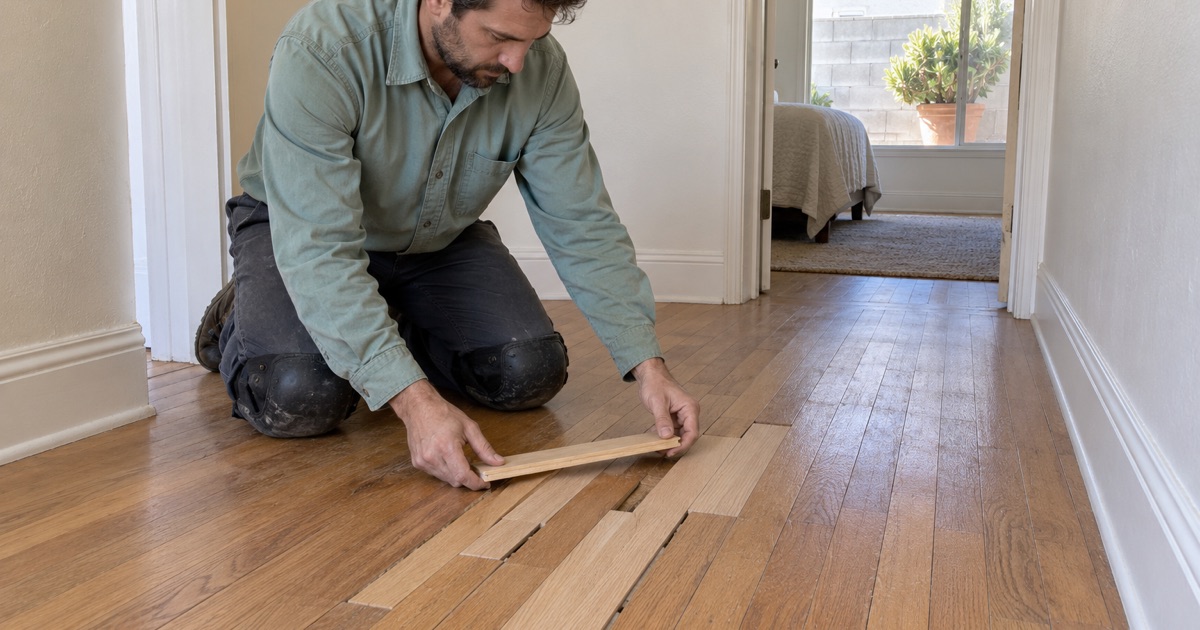
A weave-in repair removes damaged boards and replaces them with new ones staggered into the existing pattern, so the repair does not show as a square patch. We cut out the old boards, clean up the tongue and groove edges on the neighbors, and fit replacements of the same species, width and thickness. The new boards are glued and fastened so they sit flush and stay put.
On a floor that will be refinished, the repair is done first so it takes the same stain and topcoats as the rest of the room. On a floor that will not be refinished, we blend the new boards with stain and finish to match as closely as possible.
Deep Scratches, Dents and Burns
Scratches that stay in the finish can often be handled with a screen and recoat. Deeper gouges, heel dents and burn marks that reach into the wood need either board replacement or sanding, depending on how deep they go. We assess each mark and explain which approach will actually remove it, rather than filling a gouge with putty that shows in raking light.
Some marks are best left to a full refinish of the room, especially when there are dozens of them spread across a high-traffic area. In that case, repairing boards one at a time costs more than sanding the whole floor, and we say so.
Pet Urine and Black Water Stains
When urine or standing water soaks into oak, it reacts with the wood and turns it gray or black, and the discoloration usually runs deeper than a sander can reach. We run a test pass over the stain to see whether it lightens. If it does not, the affected boards are replaced with a weave-in repair, which is the only way to remove the stain rather than hide it.
Repairs to How the Floor Sits
Squeaks and Loose Boards
A squeak is a board moving where it should be fixed, either rubbing against its neighbor or sliding on a loosened fastener. On a raised house with a crawlspace, we can often work from underneath, screwing through the subfloor into the board or adding blocking between joists. On a slab or where there is no access from below, we use concealed fasteners from above and fill the holes to match.
Squeaks near a doorway or at the top of a stair often trace back to a transition piece or a nosing rather than the field of the floor. We check those first, because they are quick to fix and commonly overlooked.
Gaps Between Boards
Solid hardwood shrinks slightly in dry months and swells in humid ones, so narrow seasonal gaps are part of how the floor works. Gaps that stay open all year, or that are much wider in one area, usually point to a fastening or moisture issue. We fill persistent gaps with glued wood slivers where they are wide enough, and re-lay sections that have spread apart.
We avoid packing rigid filler into gaps that still open and close with the seasons. When the boards swell back in the humid months, rigid filler has nowhere to go and either pops out or crushes the board edges, leaving the floor worse than before.
Cupping and Crowning After Moisture
Cupping happens when the bottom of the board takes on more moisture than the top, raising the edges. We take moisture readings to find the source, whether a leak, a damp crawlspace or a slab that was never tested, and fix it first. Once readings return to normal, many cupped floors flatten on their own, and those that do not can be sanded once they are dry.
Sanding a cupped floor before it dries is a common mistake. When the moisture finally leaves, the edges that were sanded off leave the board crowned, with the center higher than its sides.
Damage From Pests and Age
Drywood Termites and Powderpost Beetles
Small round kick-out holes and piles of termite frass, tiny pellets that look like sand, are signs of drywood termites. Fine powdery dust with small exit holes can point to powderpost beetles. We recommend a pest control company treat the infestation first, and then we cut out the damaged boards and replace them so the repair is not undone by an active colony.
While the boards are out, we look at the subfloor and any exposed joists for damage, since pests rarely stop at the finish floor. Anything soft or hollow is repaired before new boards go back in.
Old Repairs That Never Matched
Many older floors carry patches from earlier repairs: boards of a different species, a different width, or a face-nailed patch that never lined up. We can remove those patches and weave in proper replacements that match the original floor. Where the original species or width is no longer available, we source the closest match and blend it with finish.
Boards Sanded Too Thin
A floor that has been refinished many times, or once too aggressively, can reach the point where the tongue or the nail heads start to show. Those boards cannot take another sanding. We identify them, replace the worst areas, and advise honestly when the whole floor is nearing the end of its sanding life.
Matching a Repair to the Existing Floor
Species, Width and Cut
Most floors in Carson’s older houses are red or white oak in narrow strips, but widths, grades and cuts vary from house to house. We measure the existing boards and identify the species before buying replacement material. Plain-sawn and quarter-sawn oak show different grain, and a repair that ignores the difference stands out even when the color is right.
Blending the Finish or Refinishing the Room
New wood is lighter than wood that has aged for decades, so a repaired board will not match perfectly on day one. For a small repair in a less visible spot, blending with stain and finish is usually enough. For a large repair in the middle of a living room, refinishing the whole floor afterward gives every board the same color and sheen, and we will tell you which approach your repair needs.
- 20+ Years on Wood Floors
- Moisture Readings in Writing
- Air-Basin-Compliant Finishes