Carson Wood Flooring has handled wood flooring in Lawndale and across the South Bay for more than 20 years, and nearly all of that work happens inside houses that were standing long before their current owners arrived. We refinish tired floors, replace boards that water or termites have ruined, install new hardwood and engineered floors, and rebuild the subfloor underneath when it needs it. Every job starts with the same step: we open the floor and check the decking and joists before we put a price on the finish floor.
That order matters because a price built on a guess about what sits below the carpet is a price that changes halfway through the job. We take moisture readings in the wood, and in the concrete wherever a floor sits on it, and we write them down before a single box of material is ordered. New flooring then rests in the rooms where it will be installed, with its moisture content logged when it arrives and again before the first board goes down.
The rest of this page covers what that approach means here specifically. It walks through the age of the houses, the city’s plans for new housing, and the choices owners and landlords face with the floors they already have.
Lawndale’s 2,497-Unit Housing Target and the Homes Already Standing
Where the New Housing Is Planned
Lawndale’s share of the state’s sixth-cycle housing need is 2,497 units for 2021 through 2029, as allocated by the Southern California Association of Governments. That total breaks down to 732 very low income, 311 low, 371 moderate and 1,083 above moderate units. When the state Department of Housing and Community Development reviewed the city’s adopted housing element in April 2022, it wrote that the city’s entire allocation is accommodated on nonvacant sites. In plain terms, the plan places new homes on land that is already being used for something else.
The city’s General Plan Update points the same direction, anticipating growth at infill locations primarily within the Hawthorne Boulevard Specific Plan area. Its environmental review describes a buildout of up to 15,405 housing units by 2045. In a city of 1.97 square miles, all of it land, that growth has to fit between buildings that are already there rather than spread across open ground.
What Residents Said About Their Own Houses
The same state review recorded something much closer to our daily work. Survey responses from residents, it noted, highlighted the need to complete modest to major rehabilitation to their existing homes. A housing target on paper does not change the fact that people are living right now in houses that have carried families for decades.
Floors sit near the top of any rehabilitation list for practical reasons. They take more wear than any other finished surface in a house, they record every leak and every pet, and they are one of the few upgrades that changes how a whole room feels without moving a wall. We treat a floor job in an older Lawndale house as part of keeping that house in good service, not as a cosmetic add-on.
Sizing the Job to the House
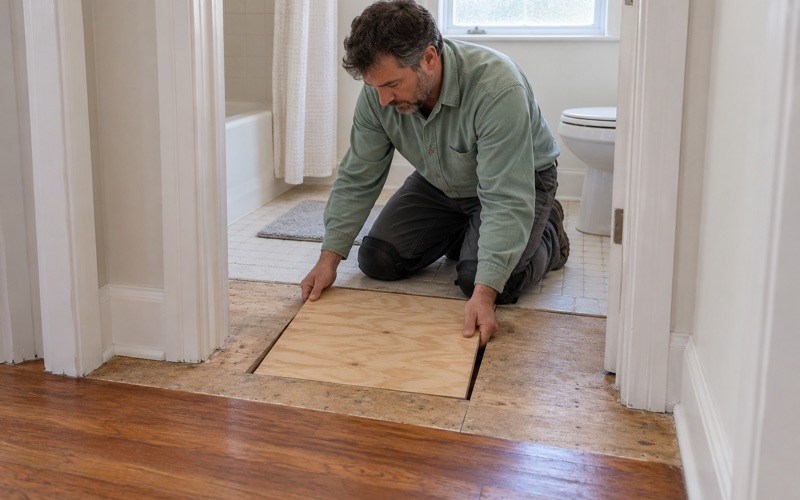
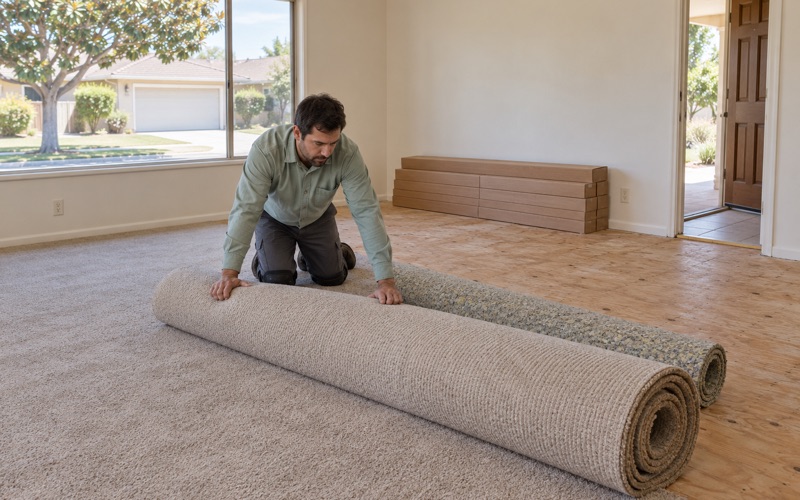
A modest rehabilitation might be a screen and recoat on a floor that is dull but sound. A major one might mean pulling up two layers of old covering, sistering a joist that has sagged, and laying new plywood underlayment before any hardwood goes in. We price those as separate scopes in writing, so an owner can see which pieces are necessary now and which can wait for the next budget.
Looking for wood-flooring closer to Watts? See Watts Wood-Flooring.
Floors in Lawndale’s 1950s and 1960s Houses
The housing numbers explain why so much of our work here is repair and refinishing rather than first installs. Of the 10,259 housing units counted in the 2024 five-year American Community Survey, 71.7 percent were built before 1980. The 1960s were the largest single decade, at 21.7 percent of the stock, with the 1950s close behind. The city itself incorporated on December 28, 1959, right in the middle of that building wave.
Lead Paint and Old Adhesives Come First
A house built before 1978 may carry lead paint somewhere, and sanding a floor or pulling baseboard and shoe molding can disturb it. We follow lead-safe work practices on pre-1978 housing, which covers most of the homes in this city, using the containment and cleanup methods the EPA Renovation, Repair and Painting rule describes. That means plastic sheeting on doorways, controlled dust and a room that is checked before it is handed back.
Old flooring layers raise a second question. A 9x9 asbestos floor tile or the black mastic beneath it can contain asbestos, so we treat either one as a possible asbestos question and recommend an asbestos survey before anything is sanded, scraped or ground. SCAQMD Rule 1403 governs how asbestos-containing material is handled in this air basin, and we would rather stop and test than find out the hard way.
What Is Under the Covering Is Not Known Until It Is Opened
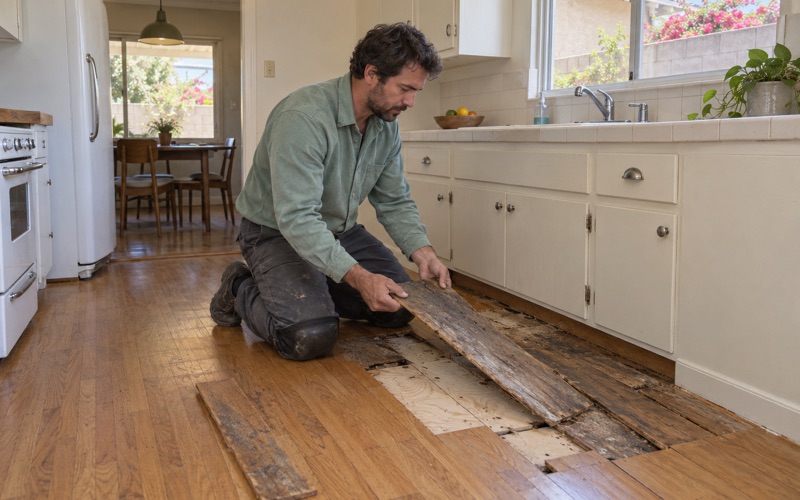
We do not assume what a 1950s or 1960s house here has under its carpet or vinyl, because nobody publishes that and houses of the same age were finished differently. Some have wood worth saving, some have a patchwork of earlier repairs, and some have decking that has been wet for years. Opening a small section before pricing tells us which of those we are looking at.
Once the covering comes up, we check the decking for soft spots and water swelling, the joists for sag or damage, and the boards for drywood termite kick-out holes and frass. Anything we find is photographed and written into the estimate before a finish floor is priced. That way it does not surface later as a callback or a surprise change order.
Finishes Chosen for This Air Basin
Lawndale sits in the South Coast air basin, where SCAQMD Rule 1113 sets a 275 g/L VOC limit for wood coatings. Every finish we apply is a product legal to use here, whether that is a waterborne polyurethane, an oil-modified polyurethane or a hardwax oil finish that meets the limit. We walk owners through sheen level, color and cure time before the sanding starts.
Detached Houses, Owned or Rented Whole
Detached houses make up the core of the city’s stock: 56.9 percent of Lawndale units are one-unit detached homes, with attached units, small apartment buildings and larger complexes making up the rest. Many of those detached houses are rentals. The same survey counts 2,788 renter households living in a detached house, 45.4 percent of renter households in the city.
Floors in a House Rented Whole
A house rented whole wears its floors much like an owner-occupied one, but the decisions about it are made on a lease calendar. Tenants drag furniture along the same path for years, pets leave urine stains that soak past the finish, and a slow leak under a sink can go unreported until the boards start cupping. By the time the owner sees the floor between tenants, it may need more than a recoat.
We write estimates and invoices that list each repair separately, with the cost of each item. Under Civil Code 1950.5, a landlord deducting from a security deposit has to itemize repair costs, and a floor invoice that lumps sanding, board replacement and finish into one number is hard to use for that purpose.
Water Damage and Insurance Claims
When a floor has been damaged by a leak, we trace the water back to its source before quoting the repair, because replacing boards over an active leak only repeats the loss. We document what we find with photos and wood moisture meter readings an insurance adjuster can work from. Owners and landlords get the same record whether a claim goes forward or not.
Stairs and Transitions
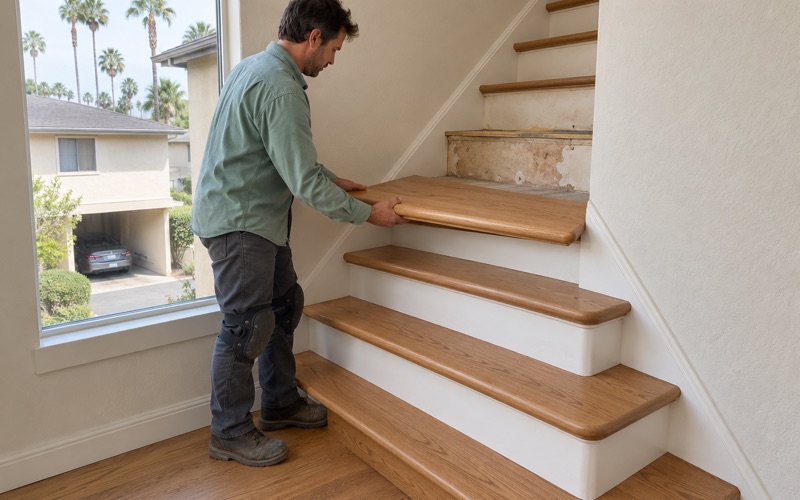
Stairs are priced per tread and riser rather than folded into a square-foot number, since each one is sanded, fitted at the nosing and finished largely by hand. Reducer strips, T-molding and new shoe molding along the walls are listed as their own line items too. In a family home or a unit between tenants, that level of detail lets an owner decide what gets done now and what waits.
Refinish, Repair or Replace Before a Sale or a New Lease
Many of the calls we take from Lawndale owners come at a turning point: a house going on the market, a tenant moving out, or a family finally starting the rehabilitation it has put off. The right answer depends on what the existing floor can still take.
When Refinishing Is Enough
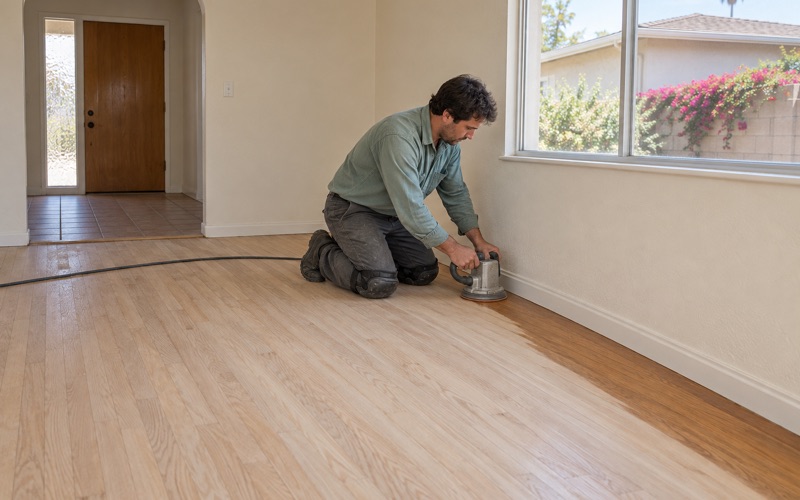
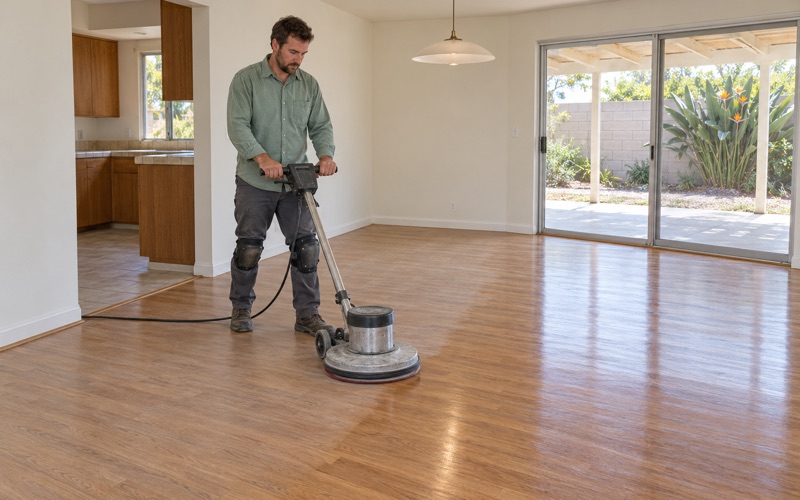
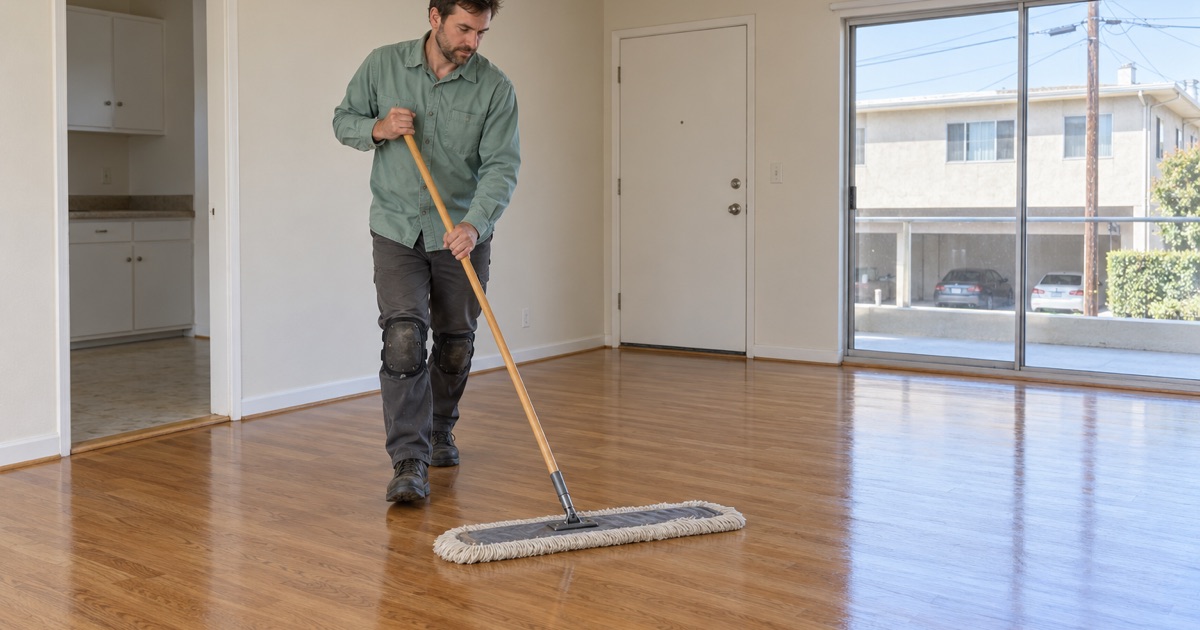
If the wood is sound and there is enough material left above the tongue, a full sand and refinish brings it back at a fraction of replacement cost. We run a proper grit sequence with a drum sander, edger and orbital sander, and we use a dustless sanding system so an occupied house is not coated in fine dust. A floor that is only dull and scuffed can often be handled with a screen and recoat in a day.
When Repair Makes More Sense
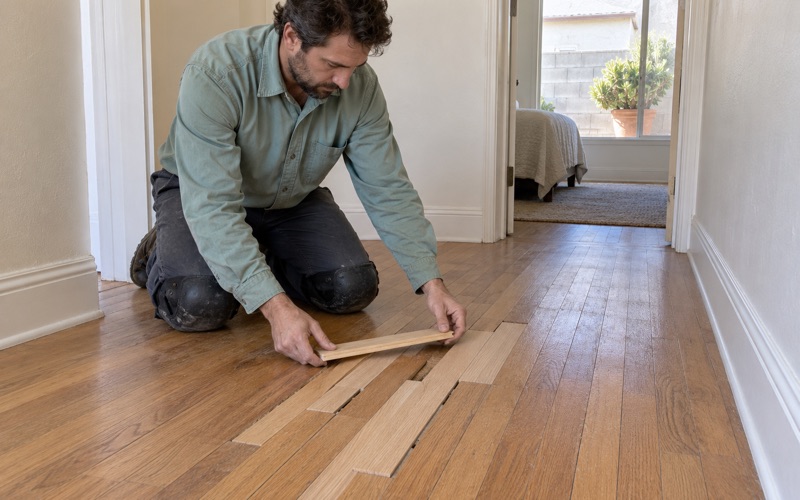
Boards that have cupped, crowned or been eaten by termites can usually be cut out and replaced with a weave-in repair that blends into the surrounding floor. Squeaks and board gaps are usually a fastening or subfloor issue, fixed from below or with new cleat nails before the floor is refinished. Blotchy stain and peeling polyurethane left by an earlier job are sanded back to bare wood and redone properly.
When Replacement Is the Honest Answer
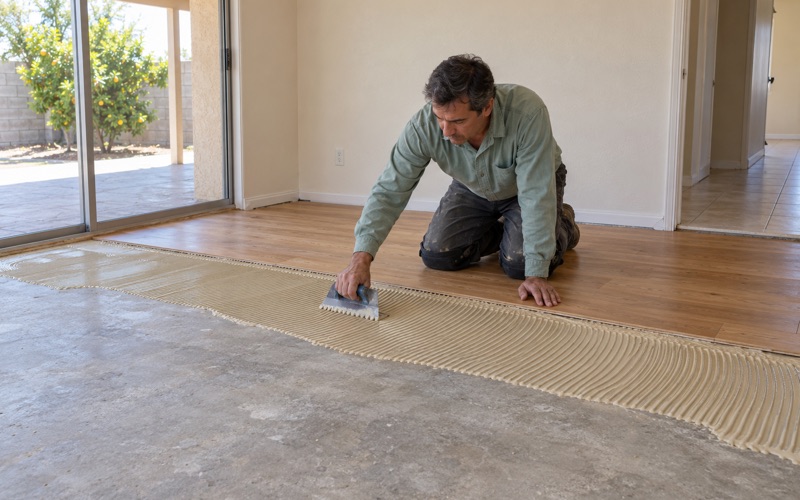
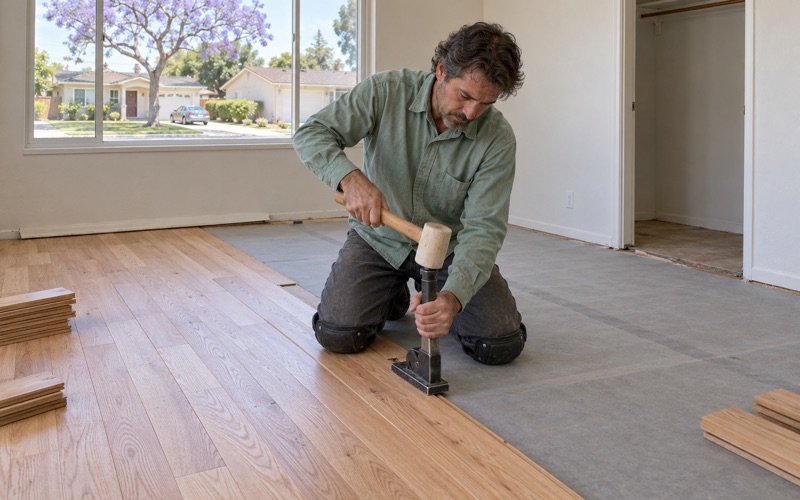
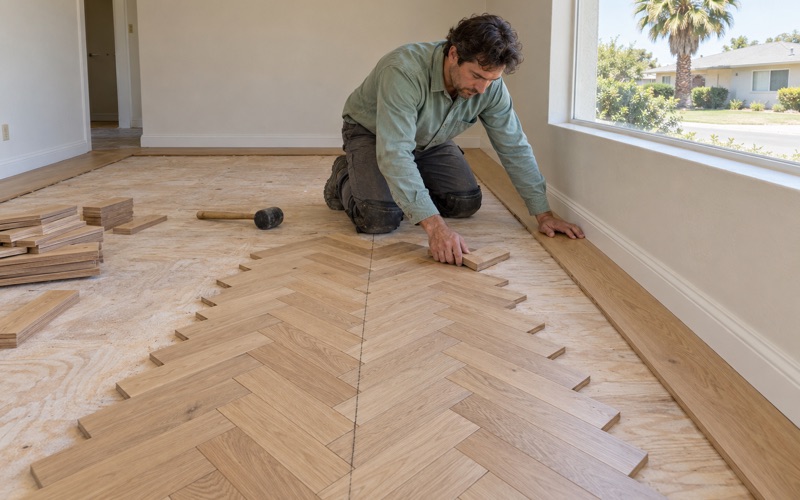
Some floors have been sanded too many times, soaked too often, or laid over decking that no longer holds a fastener. In those cases we recommend replacement, choosing between solid species such as red oak, white oak, hickory or maple and engineered boards with a stated wear layer thickness. Installation follows the NWFA installation guidelines, whether the method is nail-down, glue-down or floating, with the proper expansion gap at every wall.
Whatever the scope, we contain the dust, hand over a written cure schedule, and tell the household when each room can be walked on and when furniture can go back. Questions about whether a particular job needs city review go to City of Lawndale Building & Safety, part of the Community Development Department on Burin Avenue, which handles permits, inspections and plan check.
- 20+ Years on Wood Floors
- Moisture Readings in Writing
- Air-Basin-Compliant Finishes