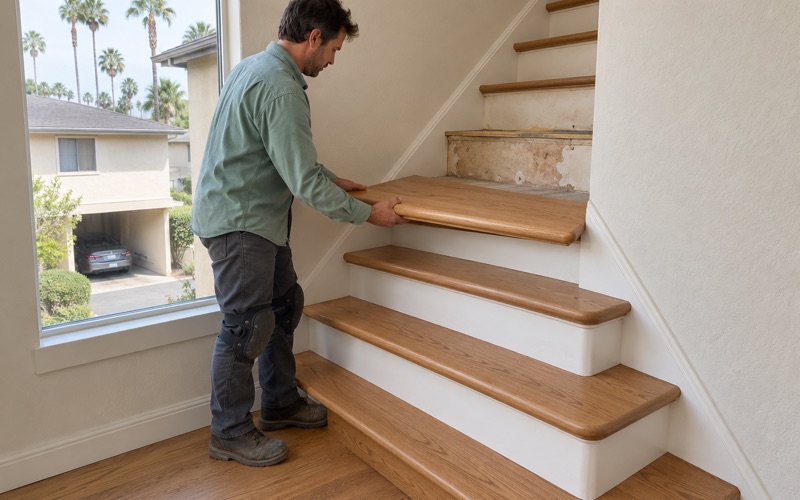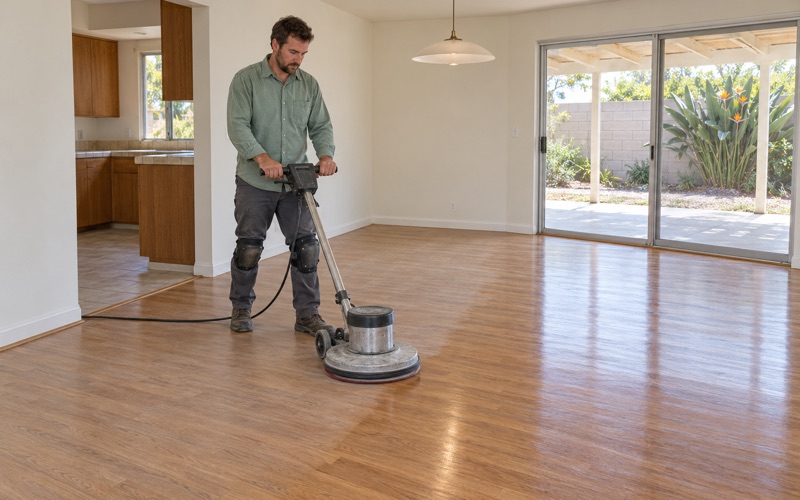
Carson Wood Flooring has spent more than 20 years on wood-flooring in Long Beach and the surrounding area, and a large share of that work is for people who own apartment buildings. We repair damaged boards, refinish worn units between leases and install new hardwood or engineered floors in buildings that stay occupied while we work. The goal on every job is a unit whose floor reads as sound, clean and looked after.
Most of what we do for building owners happens in the gap between a move-out and a move-in. A unit turns over, the finish shows every year of the last lease, and the owner needs a clear scope, a price and a date the unit can be shown again. We put all three in writing before any sanding starts.
That written record also keeps a building’s history straight. It says what was done to which unit and when, so the next turnover starts from facts instead of guesses about when a floor was last refinished.
How Long Beach Inspects Its Rental Buildings
Long Beach does not wait for complaints before looking inside its apartment buildings. The City Council adopted the Proactive Rental Housing Inspection Program, known as PRHIP, in June 2015, and it sits in the Long Beach Municipal Code as Chapter 18.30. Section 18.30.120 authorizes the city to conduct periodic inspections of residential rental properties for compliance with building, housing and sanitation codes.
The program covers multi-unit properties of four or more units and is run by the Code Enforcement Bureau, which takes calls at 562.570.CODE. Under the program, a sample of units at each property is inspected, commonly described as 10 percent, rather than every door in the building.
What the 2016 Numbers Showed
A July 2017 memo from the city’s Development Services director put approximately 75,000 rental units under the program’s purview, though other city figures count the pool differently. In calendar 2016, inspectors looked at 9,831 units under PRHIP and found violations at 2,424 of them, about 25 percent. Another 431 units were still in violation more than 120 days later.
Complaint-driven inspections at multi-unit buildings that same year found violations at about 33 percent of the units involved. These are the most recent program figures we have read, so we treat them as a picture of 2016 rather than a rate that holds today.
What the Program Does and Does Not Say About Floors
We want to be plain about the limits here. The city’s PRHIP page describes its inspections in terms of building, housing and sanitation codes, and it does not publish a checklist, so we have no floor item to point an owner to. What we offer is floor work that keeps a unit in the condition an owner wants it in whenever anyone walks through, whether that is an inspector, a prospective tenant or a lender.
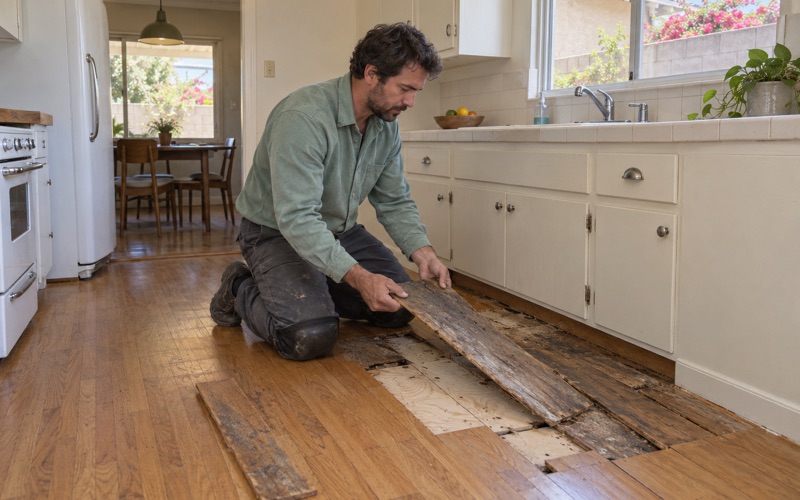
Where floor damage is really a symptom, such as a board gone soft from a slow leak under a sink, the repair starts with the water rather than the wood. We trace the source, photograph it and take moisture readings before anything is replaced. The owner ends up with a record that shows what failed, why, and what was fixed.
Looking for wood-flooring closer to Paramount? See Paramount Wood-Flooring.
Turning a Unit’s Floor Between Tenants
Long Beach is a renters’ city. Of its 170,927 occupied housing units, 100,564 are rented, or 58.8 percent, and 57.1 percent of renter households live in buildings of five or more units. That adds up to a very large number of floors that see a new household every few years and have to be brought back each time.
Screen and Recoat or a Full Sand
A finish that is dull and scuffed but still intact over the wood is a candidate for a screen and recoat. We abrade the top coat and lay down fresh polyurethane without cutting into bare wood, which is the quickest turn we offer and saves the wear layer for later. Once the finish has worn through at a doorway, grayed in a traffic lane or started peeling in sheets, a recoat will not bond and the floor needs a full sand.
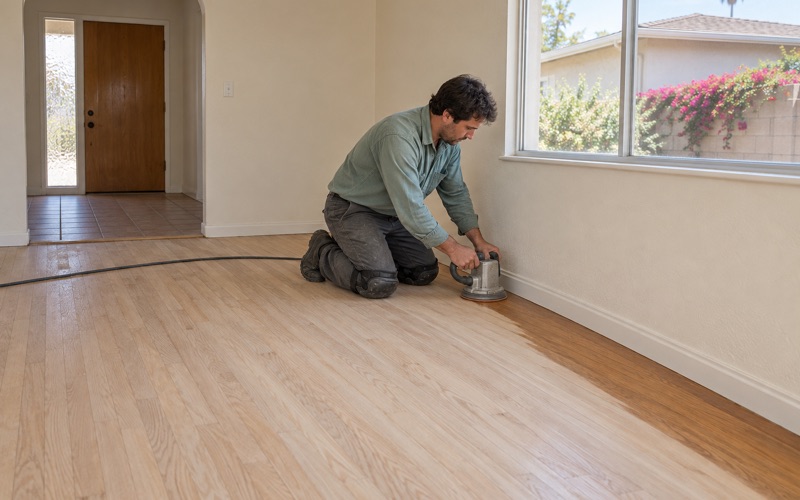
A full refinish runs a grit sequence with a drum sander or orbital sander, an edger along the walls, then stain if the owner wants it and new finish coats. On engineered floors we measure wear layer thickness first. A thin wear layer may allow one more sanding or none, and it is better to know that before quoting than halfway through the job.
Repairing Damaged Boards
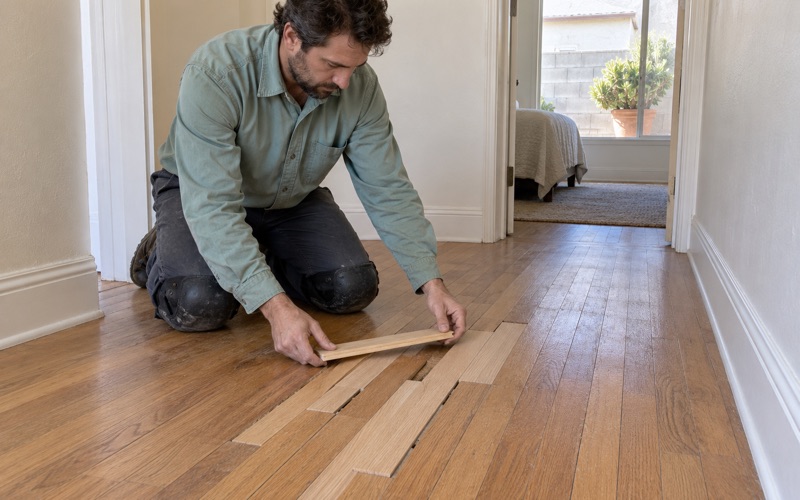
Turnover often uncovers damage a rug was hiding: pet urine stains gone black into the grain, a burn mark, a gouge from a dragged appliance, or cupping near a bathroom door. Individual boards can be cut out and replaced with a weave-in repair, where new boards are staggered into the existing field so the patch does not read as a square. We match species and width, and then blend the repair into a refinish so the color evens out across the room.
Blackened urine stains usually run deeper than sanding can reach, so we replace those boards rather than promise they will sand out. Cupping and crowning tell us moisture got in from somewhere. We find that source before closing up a repair that would otherwise cup again within a season.
Paperwork a Landlord Can Use
Every turnover job gets a written estimate before work and an itemized invoice afterward, broken out by unit and by task. Stairs in a townhouse-style unit or a shared hallway are priced per tread and riser rather than folded into a square-foot rate. When a deduction from a security deposit is on the table, that breakdown is the kind of itemized repair cost California’s deposit law under Civil Code 1950.5 expects an owner to show.
Refinishing an Occupied Building One Unit at a Time
In a building of five, twenty or fifty units, the unit being refinished shares walls, hallways and sometimes ventilation with homes where people are living. We plan the work so the neighbors notice as little of it as possible. That means containment, a predictable schedule and finishes that suit a building where nobody else is moving out.
Dust and a Written Schedule
We sand with a dustless sanding system connected to the sander and edger, and we seal the unit door and any shared returns before the first pass. Each unit gets a written cure schedule stating when it can be walked on in socks, when furniture can go back and when rugs can go down. A property manager can book the next showing against that date instead of guessing.
Finishes Legal in the South Coast Air Basin
Long Beach falls under the South Coast Air Quality Management District, whose Rule 1113 limits wood coatings to 275 g/L of volatile organic compounds. We choose finishes only from products that meet that limit. In an occupied building that usually means a waterborne polyurethane, which carries less odor into the hallway and recoats faster than an oil-modified polyurethane.
Some owners prefer a hardwax oil finish, because a worn spot can be touched up between tenants without refinishing the whole room. When that is the request, we confirm the specific product meets the district limit before we order it.
Installing New Floors in Vacant Units
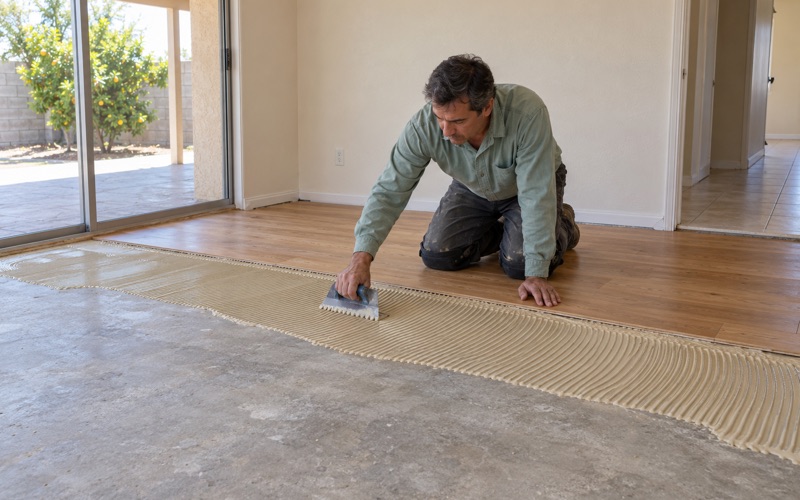
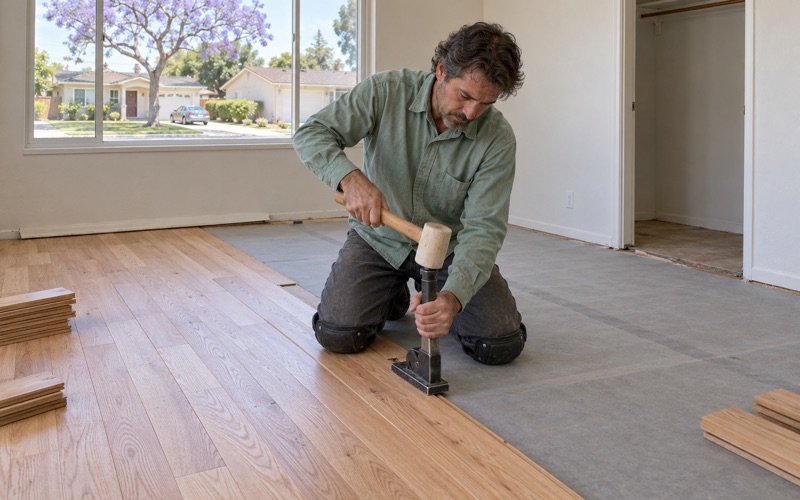
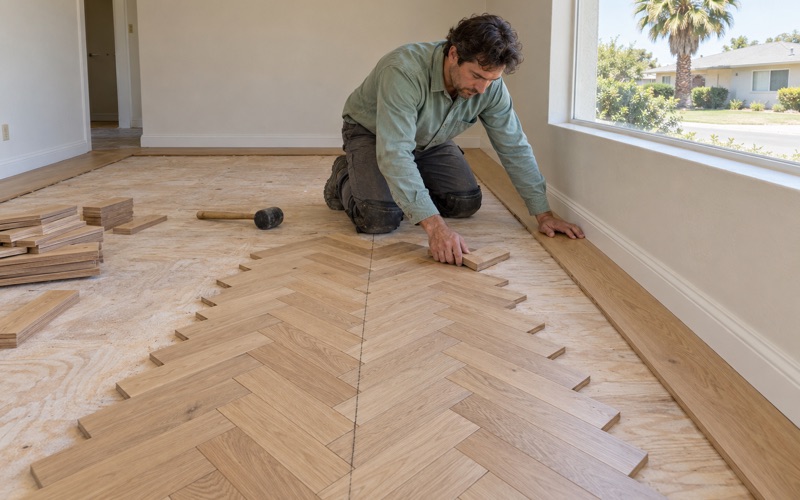
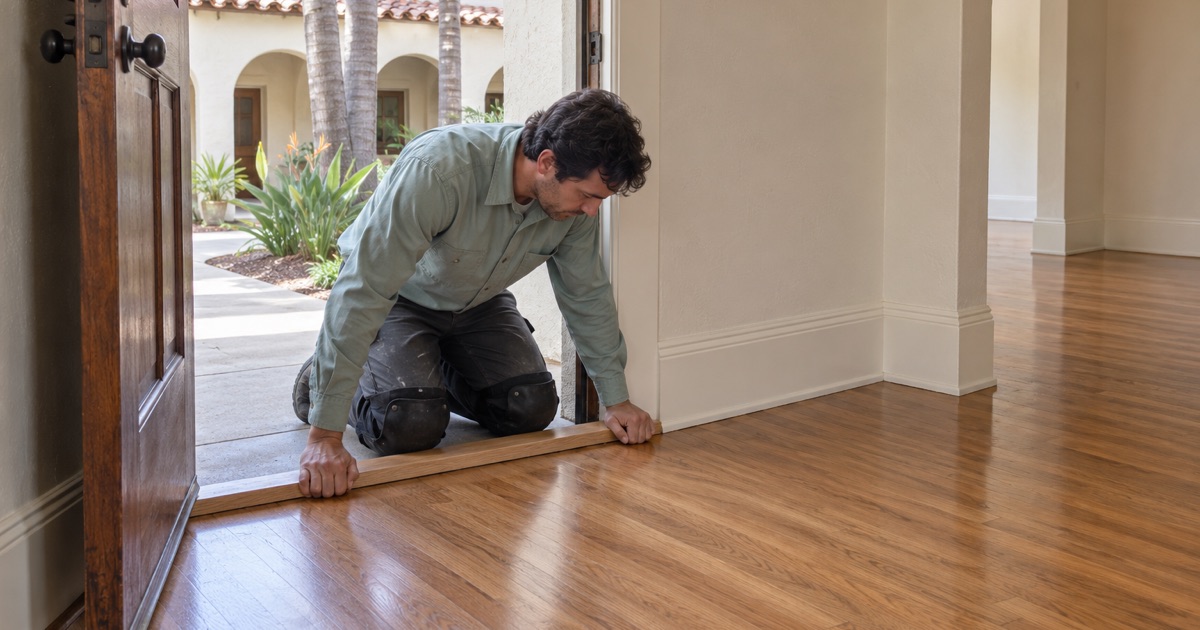
When a worn floor is past saving, we install new hardwood or engineered flooring in the vacant unit. Material is delivered to the unit it will live in and acclimated there, with moisture content logged on arrival and again before installation. We also test the subfloor, with a wood moisture meter on plywood and a calcium chloride or ASTM F2170 in-situ relative humidity test on concrete, and we write every reading down.
For a rental that will see hard use, species choice matters as much as looks. We walk owners through the Janka hardness rating of white oak, hickory and maple against softer options, and through nail-down, glue-down and floating installation, so the floor is picked for the next ten tenants rather than the first.
Older Buildings, Older Floors in Long Beach
Long Beach’s housing is old by California standards. Of its 181,477 housing units, 19.2 percent were built before 1940, 52.3 percent before 1960 and 78.6 percent before 1980. Whether a building sits in Belmont Heights, Wrigley, Bixby Knolls or North Long Beach, we ask for its build date before we quote, because age changes what is under the floor and how the job has to be run.
Lead-Safe Practice on Pre-1978 Buildings
A building from before 1978 can carry lead-based paint on baseboards, shoe molding and door casings, all of which a floor job disturbs. We follow the lead-safe work practices of the EPA Renovation, Repair and Painting rule on pre-1978 housing. Where a build date is unclear, we treat the unit as if it falls in that group until shown otherwise.
Old Tile and Black Mastic
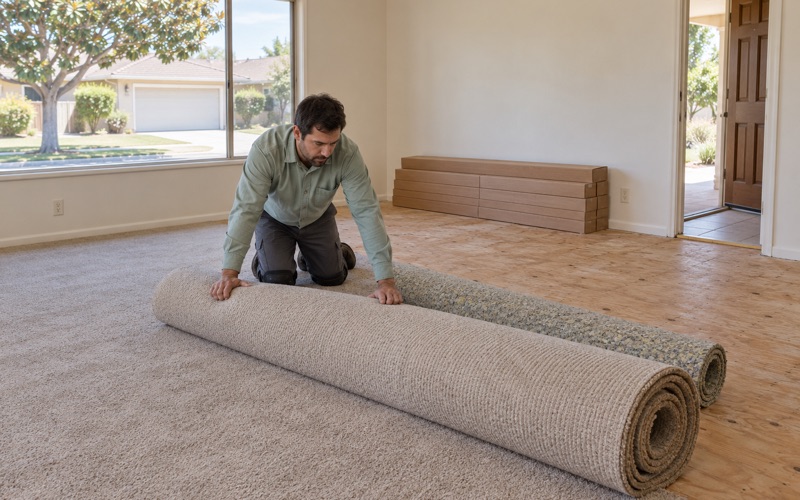
Older units often hide layers under carpet or sheet vinyl, including 9x9 floor tile set in black mastic. Both can contain asbestos, so we treat them as an asbestos question before anything is sanded or scraped. An asbestos survey settles it, and confirmed material is removed under SCAQMD Rule 1403 by the people qualified to handle it, not by our sanders.
The Subfloor Before the Price
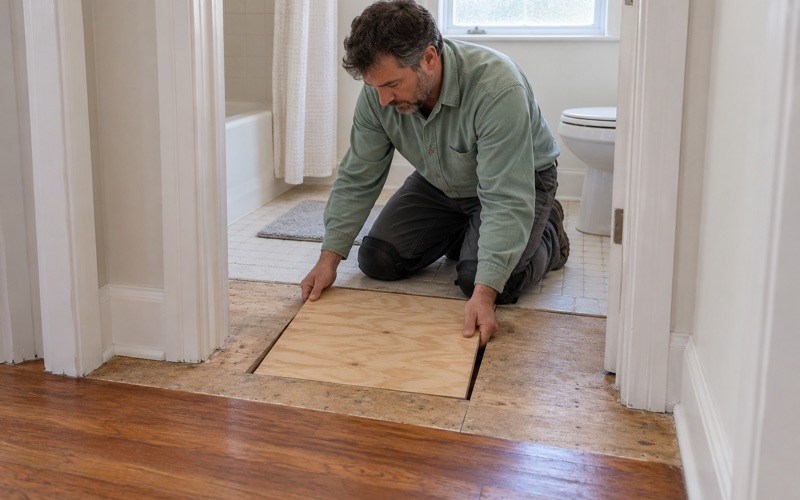
In an old unit, a squeak, a soft spot or a sloping floor often starts below the finish boards. We open and check the subfloor before pricing new flooring, looking for water-swollen decking, failed plywood underlayment and floor joists that need sistering. Finding that at the estimate costs an owner far less than finding it after the new floor is down and the next tenant has moved in.
- 20+ Years on Wood Floors
- Moisture Readings in Writing
- Air-Basin-Compliant Finishes