Carson Wood Flooring has spent more than 20 years on wood-flooring in Palos Verdes Estates and the rest of the South Bay, and the jobs we slow down for here are the oldest ones. When a house may have boards from its first decade hidden under later carpet, the work stops being a replacement and becomes a search. We look before we price, because the right answer depends on what is actually under there.
In practice that means lifting a corner of carpet in a closet, reading the boards with a wood moisture meter, and opening enough of the floor to see the decking and joists before a number is written down. The goal is a written record of the existing floor: its condition, its moisture content, how much wood remains above the tongue, and what it would take to bring it back. Soft spots and swollen decking found now are cheaper than callbacks found later.
This page is for owners of the small group of homes that date to the founding years, and for anyone who suspects an older floor sits under something newer. Most of the city went up decades later, which makes the early floors rarer and worth more care.
The First Buildings and What One Nomination Says About Their Floors
The founding layer of Palos Verdes Estates is thin, and it helps to know how thin before deciding what an old floor is worth. The clearest written description of a founding-era interior comes from a single National Register nomination, and it says a good deal about floors.
Where the Founding Buildings Came From
Development began in 1923, with Frederick Law Olmsted Jr. and Charles Cheney as planners. Clarence E. Howard, an architect employed by the Olmsted Brothers, designed many of the beginning commercial and residential buildings for what was then called the Palos Verdes Project. The city did not incorporate until December 20, 1939, so the earliest buildings are older than the city itself.
Census figures show how small that group is. Of 5,370 housing units, 241 were built in 1939 or earlier, which is 4.5 percent of the housing stock. The building boom came much later: 52.0 percent of homes went up between 1950 and 1969, so a 1920s floor is the exception on almost any street.
The Mirlo Gate Lodge Tower in Valmonte
The Mirlo Gate Lodge Tower at 4420 Via Valmonte is described in its nomination as one of the first buildings built for the Palos Verdes Project, and the nomination gives its construction as 1925. Howard designed it, with walls of Palos Verdes stone, a local limestone, laid in lime mortar. It was added to the National Register of Historic Places in April 2019.
The nomination also calls the tower largely unchanged since 1925, with excellent integrity. That makes it a useful reference point, because it records what an early building looked like without decades of remodeling layered over it.
What the Nomination Records Underfoot
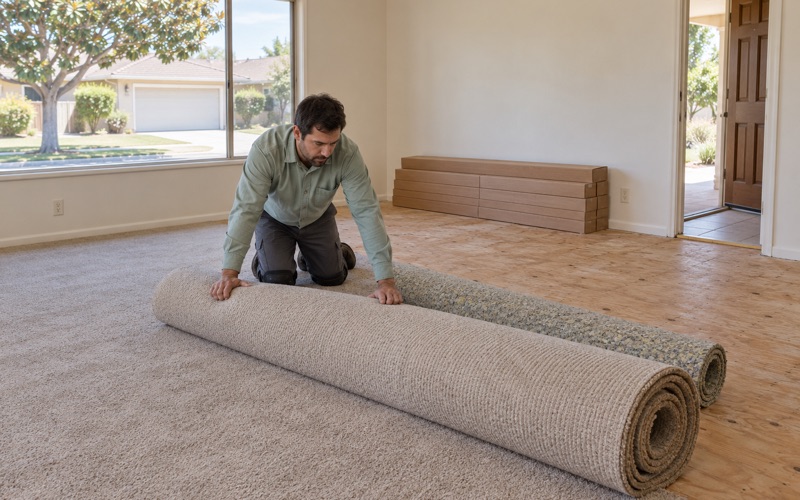
The interior description walks through the tower floor by floor. On the first floor, “The floor is carpeted, with wood planks likely underneath,” and the upper floor is carpeted as well. In the basement, “Wood ceiling joists and floor planks are exposed, and are original.”
That is one small gate tower, and we do not read it as a description of Palos Verdes houses. What it shows is a pattern we look for on every early job: carpet laid over the finish floor at some point, and the only place original wood is openly visible being the space nobody thought worth covering.
Looking for wood-flooring closer to El Segundo? See El Segundo Wood-Flooring.
Finding a 1920s Floor Under Later Carpet
Most owners who call us about an old floor have not seen it. They know the house is early, or they found a strip of wood at a doorway, and they want to know whether it is worth uncovering. The survey below is how we answer that without tearing out a room first.
Where We Look First
We start where carpet can be lifted and re-stretched with little trace: a closet corner, the edge of a room along a wall, or a stair landing. Removing a floor register cover often shows the flooring edge in cross-section, which tells us board thickness and whether the wood is solid or a later overlay.
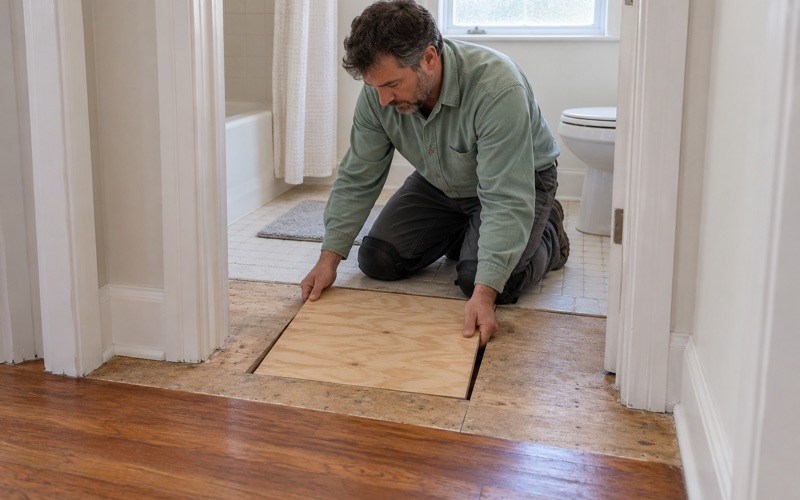
We also check underneath wherever the structure is reachable, looking at floor joists, decking and any signs of drywood termite activity such as frass or kick-out holes. Old boards with powderpost beetle damage or soft decking beneath them change the plan before the finish floor is even discussed.
What We Record Before Quoting
We identify the species from the boards themselves rather than assuming one, because an early floor can be anything and the repair stock has to match. We note board width, nail pattern, tack strip holes, staple scars and stains, including pet urine stains that may have gone through the finish into the wood.
Moisture content is read with a meter across several rooms and written down, so a cupped or gapped section can be explained rather than guessed at. The most important number is how much wood remains above the tongue, because it sets how many more sandings the floor can take. A floor with little left may call for a screen and recoat instead of a full sand.
What Might Sit Between the Carpet and the Wood
Carpet is not always the only layer. Old tile or black mastic under a later floor is treated as a possible asbestos question, and 9x9 asbestos floor tile in particular is never sanded or scraped until an asbestos survey says what it is. SCAQMD Rule 1403 governs how asbestos-containing material is handled if the answer is yes.
A house from the 1920s also falls well inside pre-1978 housing, so we use lead-safe work practices under the EPA Renovation Repair and Painting rule whenever old painted trim, baseboards or stairs are disturbed. That matters most at the edges of a room, where shoe molding and baseboard come off before the floor can be reached.
Valmonte, Malaga Cove and the Founding Layer
The early buildings are not spread evenly. The named areas of the city include Malaga Cove, Lunada Bay, Valmonte and Montemalaga, and the founding-era buildings with a documented record cluster in a few of them.
Two Early Neighborhoods
Valmonte, where the gate tower stands, was advertised as being inland on high ground. Malaga Cove holds the Palos Verdes Public Library, which was listed on the National Register in the 1990s along with Farnham Martin’s Park, and Malaga Cove Plaza, designed by Myron Hunt, is also on the Register.
None of those listings covers a private house, and none of them describes a house floor. They tell an owner something narrower: that the neighborhood’s early fabric has been studied, and that a home near these buildings is more likely than average to belong to the same founding period.
No Local Ordinance Protects the Floor
The Los Angeles Conservancy has noted that Palos Verdes Estates lacks any historic preservation policy, which prevents the city from offering protection to privately owned historic resources. There is no local list that would flag an early house or its interior. Whether a 1920s floor survives is decided almost entirely by the owner and whoever they hire.
That is why we treat an early floor as something to document before anything is removed. We photograph each room as found, mark where original boards run, and note which sections have already been patched. If the floor is later covered again, the next owner still has a record of what is underneath.
Keeping Original Boards When the Rest of the House Changes
A kitchen remodel or a new addition is when early floors are most often lost, usually because matching them looked harder than replacing them. It is usually not. The approach below keeps as much of the founding floor as the wood allows.
Repair Before Replacement
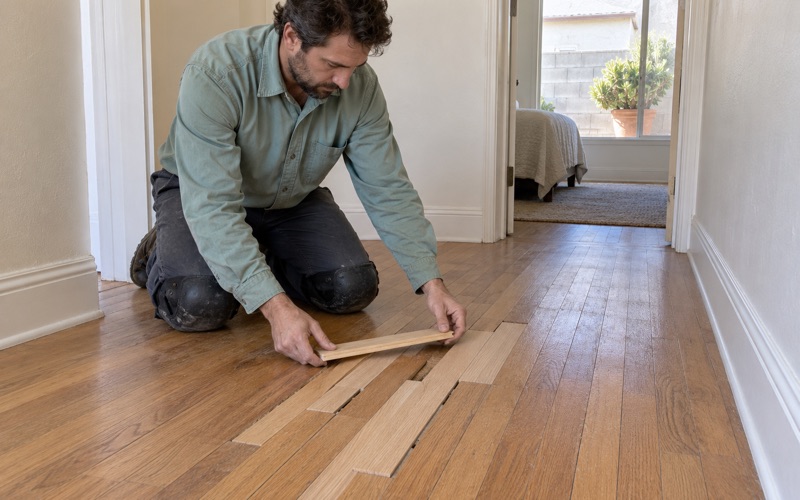
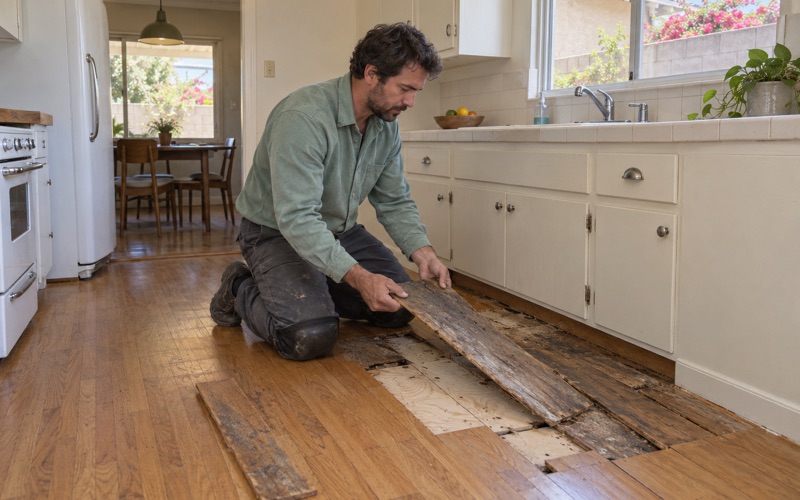
Damaged boards come out one at a time, and new or salvaged boards go in with a weave-in repair so the seams stagger the way the original ones did. When a closet or a room being converted has boards to spare, we pull those carefully and use them as repair stock, because century-old wood matches century-old wood better than anything new.
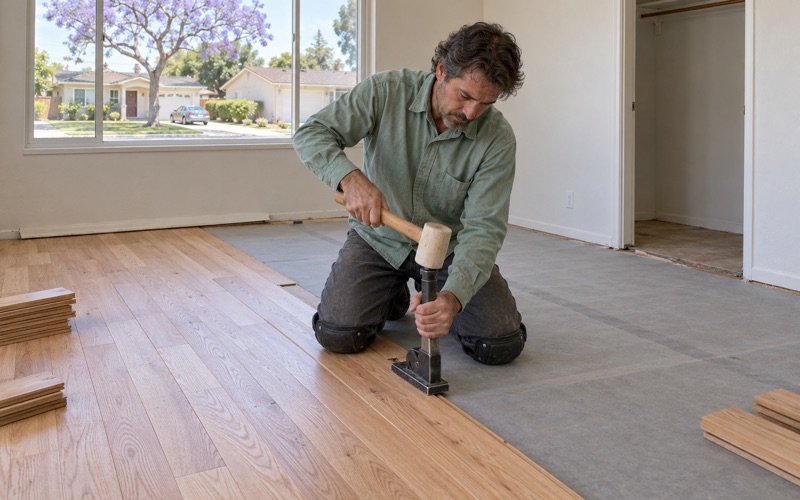
Where new material is unavoidable, it is matched for species, width and grain, then acclimated in the rooms it will live in, with moisture content logged on arrival and again before installation. Squeaks, board gaps and small sloping areas are traced to the decking or joists and fixed there, sometimes with joist sistering, rather than covered over.
Sanding an Early Floor
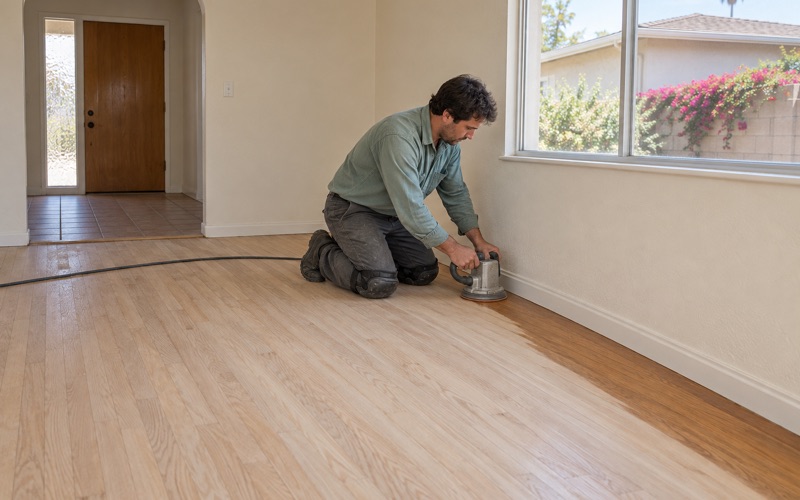
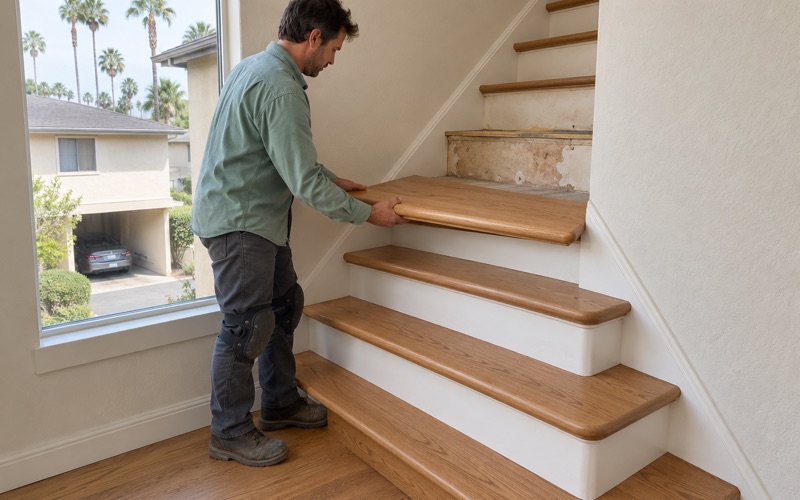
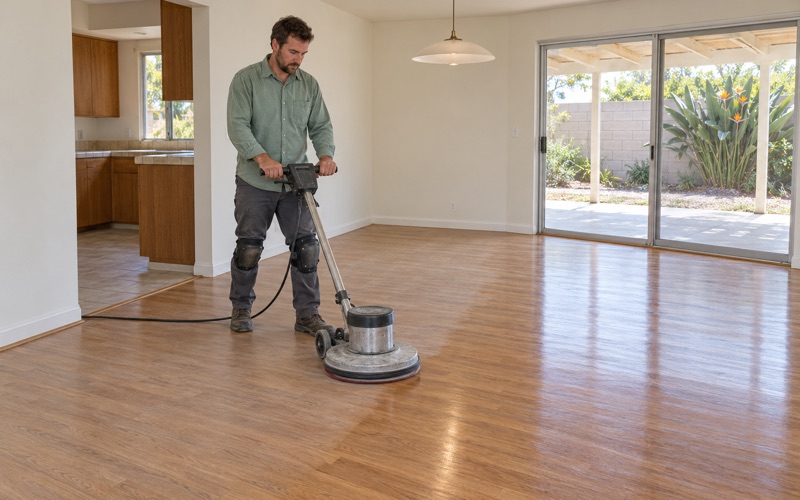
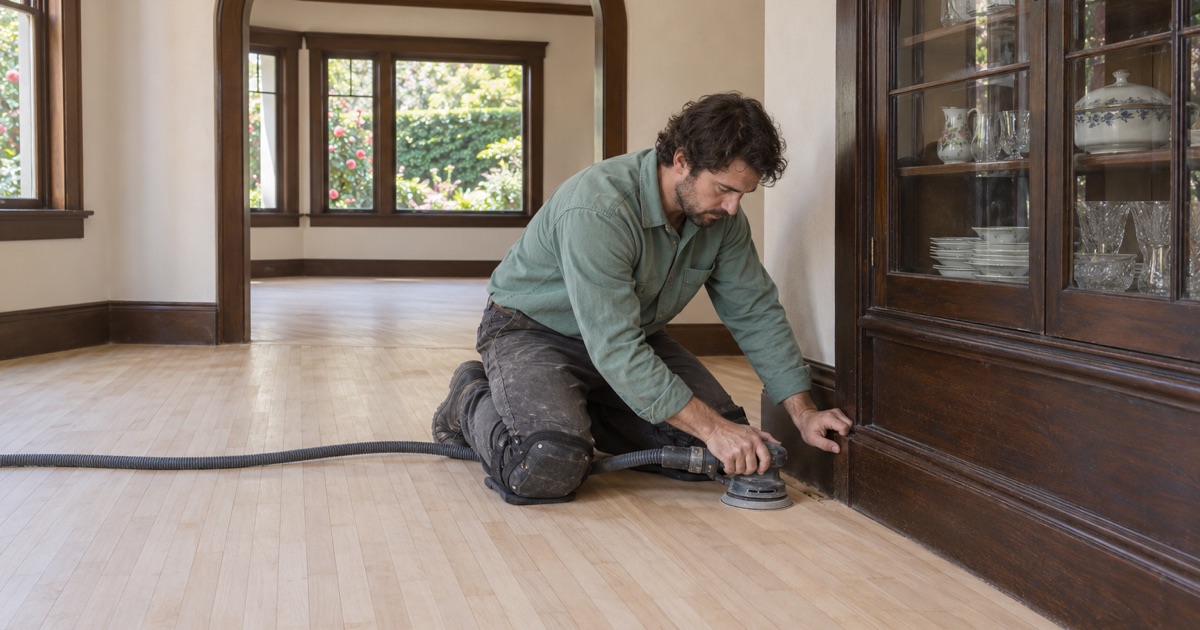
An old floor gets a conservative grit sequence, starting no coarser than the boards need, with the drum sander and edger kept moving and a dustless sanding system connected throughout. If the survey showed thin wood, we recommend a screen and recoat instead and say so in writing. Stairs are priced per tread and riser rather than folded into a square-foot figure.
Finish and Cure
Finishes are chosen from products legal to apply in the South Coast air basin under SCAQMD Rule 1113, which caps wood coatings at 275 g/L of VOC. Waterborne polyurethane, oil-modified polyurethane and hardwax oil each change the color of old wood differently, so we lay test patches on the actual boards before the whole floor is coated.
An occupied house gets dust containment and a written cure schedule, so the household knows when each room can be walked on and when furniture can go back. The early floor then goes back into daily use, documented and in better shape than it was found.
- 20+ Years on Wood Floors
- Moisture Readings in Writing
- Air-Basin-Compliant Finishes