
Carson Wood Flooring helps homeowners replace carpet with hardwood in Carson, CA, serving surrounding cities including West Carson, Compton, Wilmington, West Rancho Dominguez, East Rancho Dominguez. Over more than 20 years, much of this work has started with a pleasant surprise: original oak that has been sitting under wall-to-wall carpet since the house was built.
Two out of three homes in Carson went up between 1950 and 1979, the era when oak strip flooring was common and carpet was later laid over it. So before we quote a new floor, we check what is already there. If sound oak is hiding under the carpet, refinishing it is often the better and less expensive option. If not, we prepare the subfloor and install new hardwood.
Checking What Is Under the Carpet
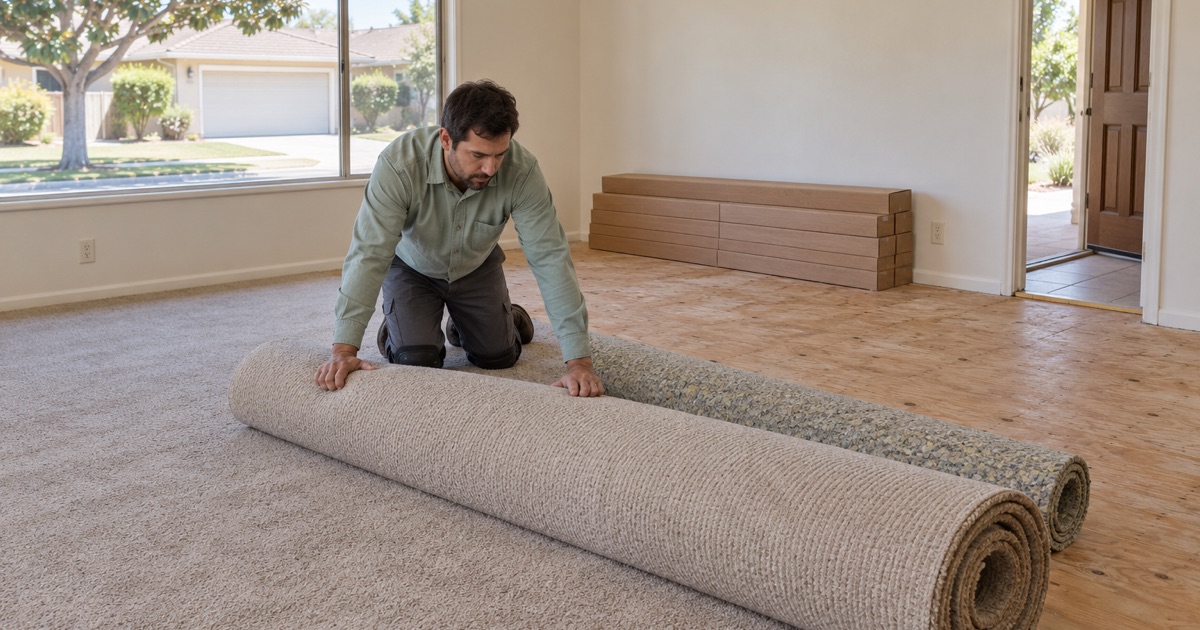
Looking for Original Oak
We lift carpet in a few places, usually inside closets and along edges where it can be put back, and check the floor underneath in more than one room. Some houses have oak throughout, while others have oak only in the living areas and plywood or particleboard in bedrooms or additions. Knowing the layout early avoids surprises halfway through the job.
Where oak is present, we check its thickness above the tongue, since that decides whether it can take a full sand. We also look for staples, tack strip damage, stains and old patches that will need repair.
Old Tile, Mastic and Lead Paint
Carpet sometimes covers older vinyl or 9x9 tile laid directly over the subfloor, often set in black mastic. Those materials can contain asbestos in houses of this age, so we treat them as a possible asbestos question before anything is scraped or sanded. In houses built before 1978, we also use lead-safe work practices around painted baseboards and trim, which are often disturbed when carpet and tack strip come out.
If There Is Hardwood Underneath
Removing Carpet, Pad and Fasteners
We remove the carpet and pad, pull every staple and tack strip, and set or pull nails that sit above the surface. It is slow work, but a single staple left behind can tear a sanding belt and gouge the floor. Once the floor is clean, we assess the damage properly in good light.
Repairs and Refinishing
Pet stains, water marks and damaged boards are dealt with before sanding, usually by weaving in matching boards. The floor is then sanded through a full grit sequence and finished with a stain and topcoat of your choosing. Every finish we apply meets the South Coast air basin’s 275 g/L limit for wood coatings, and you receive a written cure schedule for each room.
Matching Rooms That Were Never Carpeted
In many houses, the kitchen, bathrooms or a later addition were never oak, so the refinished floor has to meet tile, vinyl or new wood at the doorway. Where you want wood to continue into a room that never had it, we weave new oak into the old floor so the boards run through without a visible seam, then refinish both together.
Oak that has sat under carpet for decades is often lighter than you expect once sanded, since it has been shielded from sunlight. We show you the sanded color before any stain goes on, which helps when deciding how new and old wood will be blended.
If There Is No Hardwood, or It Cannot Be Saved
Preparing the Subfloor
When the floor under the carpet is plywood, OSB or particleboard, we check it for soft spots, water damage and loose areas, and repair or replace sections as needed. Carpet hides a surprising amount of subfloor damage, especially near bathrooms and exterior doors. Hardwood needs a flat, dry, well-fastened base, so this step comes before any new flooring is ordered.
Once the carpet is gone, we also take moisture readings in the subfloor or, on concrete, test the slab. Carpet can hide slow leaks and damp areas that did not matter under pad but will cup a wood floor, so the readings are recorded before any material is ordered.
Choosing and Installing New Hardwood
Over a wood subfloor, solid hardwood nailed down gives a floor that can be refinished many times. Over concrete, or where height is limited, engineered hardwood glued down or floated is usually the better choice. We log the moisture content of the new flooring on arrival and again before installation, and install to NWFA installation guidelines.
Details That Change When Carpet Comes Out
Door Heights and Transitions
Carpet and pad together often sit at a different height than the new floor, so doors may need trimming and transitions need planning. Where the new hardwood meets tile in a kitchen or bathroom, we use a T-molding or reducer strip sized to the height difference. We check every doorway before installation so nothing sticks or trips.
Baseboards and Shoe Molding
Baseboards that sat above thick carpet may leave a visible gap once the carpet is gone. Shoe molding covers that gap and the expansion gap around the new floor. We can reinstall existing molding or add new pieces, painted or stained to suit.
In houses built before 1978, baseboards often carry layers of old paint, so removing or trimming them is handled with lead-safe work practices. Where the old baseboard is in poor shape, replacing it at the same time as the floor usually gives a cleaner result than patching it around new wood.
- 20+ Years on Wood Floors
- Moisture Readings in Writing
- Air-Basin-Compliant Finishes