
Carson Wood Flooring installs wide plank hardwood flooring in Carson, CA, serving surrounding cities including West Carson, Compton, Wilmington, West Rancho Dominguez, East Rancho Dominguez, along with herringbone and chevron pattern floors. After more than 20 years on wood floors, we treat both as installations where planning matters more than speed.
Wide boards show off more grain and give a room a calmer, more open look, but they also move more with humidity. Herringbone and chevron patterns add movement and detail, but they demand a flat subfloor and a precise layout line. In both cases, most of the work that makes the floor look right happens before the first board goes down.
Wide Plank Floors
Why Wide Boards Move More
Every hardwood board expands and contracts across its width as the moisture content changes, and a wider board moves more in absolute terms than a narrow one. Over a season, that can show as gaps in drier months or cupping when moisture rises from below. The fix is not a different board but careful control: stable moisture readings, full acclimation in the room and the right fastening.
We log the moisture content of the planks on arrival and again before installation, and compare it with the subfloor. Wide boards are not installed until the numbers are close enough to meet the manufacturer’s requirements.
Engineered Wide Plank Over Concrete
On a slab-on-grade, wide plank is almost always engineered, because the layered core resists the movement that would cup a solid board over concrete. We test the slab before ordering and choose a glue-down or floating installation to suit the readings. A thick wear layer is worth paying for here, since it keeps the option of a future refinish.
Fastening and Adhesive on Wide Boards
Over a wood subfloor, wide solid planks often benefit from adhesive in addition to nails or staples, which helps hold the board flat across its width. Fastener spacing and adhesive type follow the manufacturer’s instructions and NWFA installation guidelines. Getting this right is the difference between a wide plank floor that stays flat and one that cups along every board.
Subfloor Flatness Under Long Boards
Long, wide planks bridge small dips in the subfloor instead of following them, which can leave a board rocking or clicking underfoot. They also show every ridge in raking light from a window. We check flatness across the whole room with a straightedge and correct high and low spots before installation.
In older raised houses, that check can reveal a sagging joist or loose decking that a narrow strip floor had been hiding for years. Fixing it before a wide plank floor goes down is far easier than living with a floor that shows the problem.
Herringbone and Chevron Patterns
Planning the Layout Line
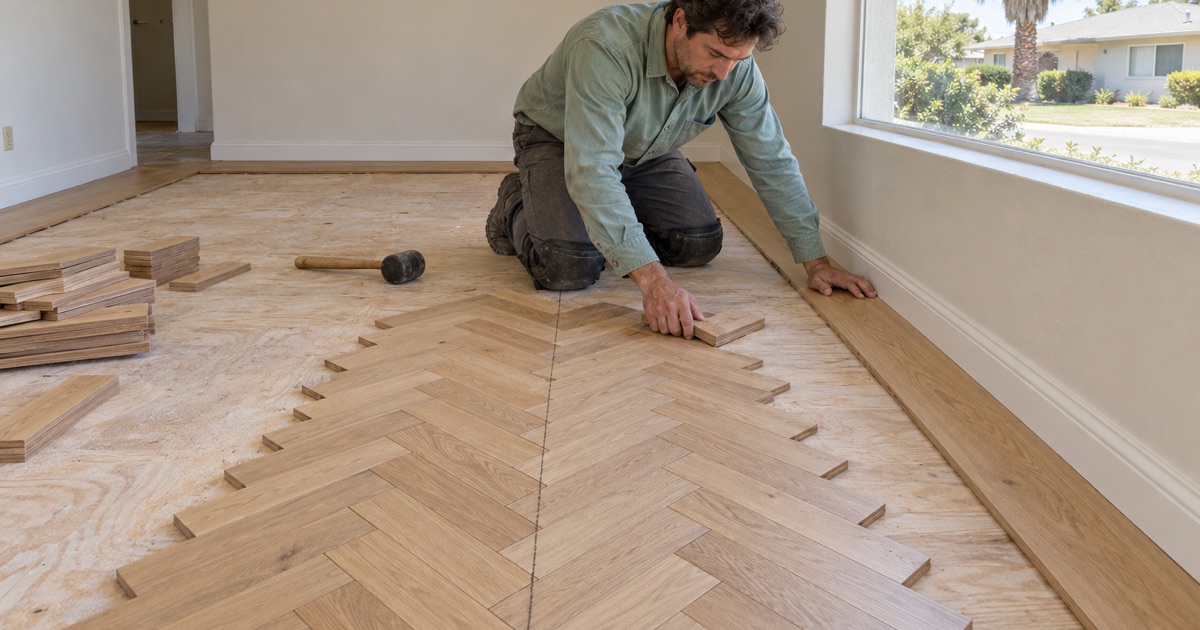
A herringbone or chevron floor is built outward from a single layout line, usually centered on the main view into the room or on a fireplace, hallway or window. Every piece is set against that line, so a small error at the start grows across the room. We snap and check the line before the first piece goes down and plan how the pattern will meet walls, doorways and adjoining rooms.
Materials and Waste Allowance
Pattern flooring comes as short, precisely milled pieces, often in left and right versions for herringbone. The edges of the room need cut pieces to fill the pattern, which means a higher waste allowance than a straight lay. We calculate the material needed from the actual room dimensions and layout, so you do not run short halfway across the floor.
Pattern pieces are glued and fastened individually, and on concrete they are usually glued down to a tested slab. Because each piece is small, a pattern floor tolerates less subfloor movement than a straight lay, which is why flatness and moisture checks carry even more weight here.
Borders and Transitions
Many herringbone floors look best framed by a border of straight boards around the room, which also simplifies the cuts at the walls. Where the pattern flows into another room, we plan the transition so the pattern either continues cleanly or stops at a deliberate break. T-molding and reducer strips are placed where they look intentional rather than improvised.
Species and Finish for Statement Floors
White Oak, Hickory and Walnut
White oak is the most common choice for wide plank and herringbone, because its grain is attractive and it takes stain and finish evenly. Hickory adds strong color variation and is among the harder domestic species on the Janka hardness scale. Walnut gives a rich dark color but dents more easily, which matters in a busy household.
Finish and Sheen
A matte or satin finish suits wide plank and pattern floors, because it keeps attention on the grain and the layout rather than on reflections. Waterborne polyurethane keeps white oak light, while a hardwax oil gives a natural look that can be spot-repaired. Every finish we apply meets the South Coast air basin’s 275 g/L limit for wood coatings.
Wire-brushed and lightly hand-scraped surfaces are popular on wide plank, because the texture hides scratches and dents. Keep in mind that a full sand later removes that texture, so a wire-brushed floor is best maintained with screen and recoat coats rather than full refinishing for as long as possible.
- 20+ Years on Wood Floors
- Moisture Readings in Writing
- Air-Basin-Compliant Finishes