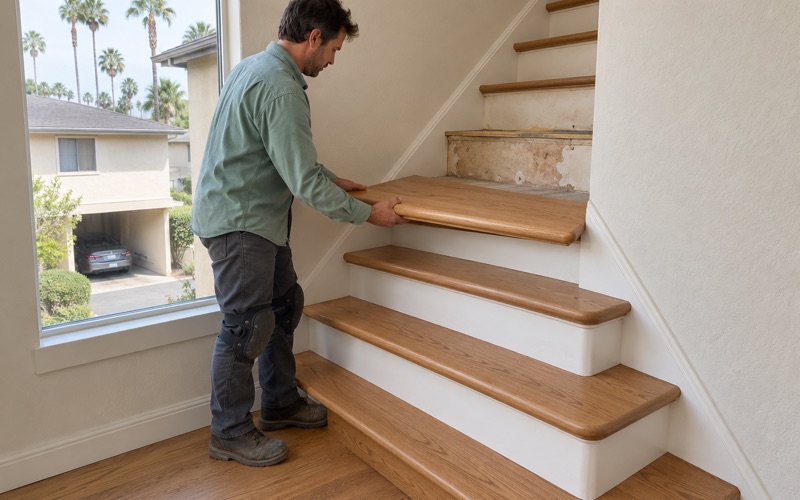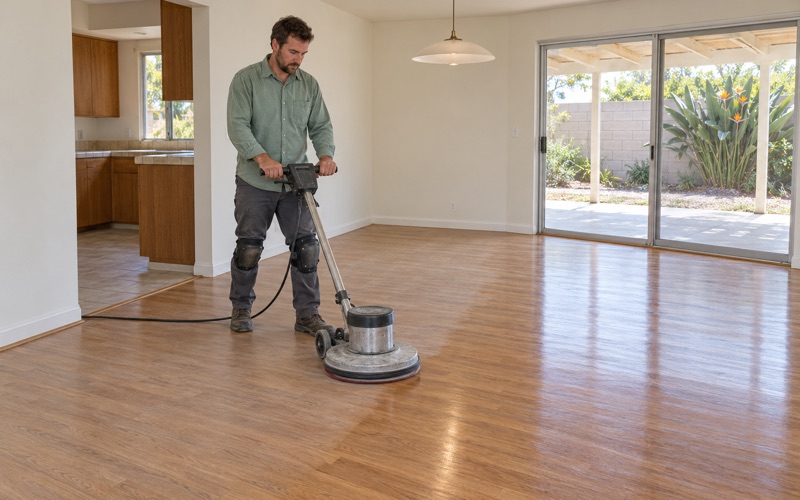
Carson Wood Flooring handles wood-flooring in Wilmington with more than 20 years in the trade behind every estimate, and most of the floors we are called about here sit inside rental buildings rather than owner-occupied houses. That changes the job. A refinish or a board replacement in an apartment is rarely just a floor question; it touches the tenant who lives on it, the owner who has to plan around inspections, and the city rules that govern older rental stock.
We work for property owners, managers and residents alike. Owners call us between tenancies or ahead of an inspection, managers call when a unit comes back with worn finish or pet damage, and residents call when a squeak or a lifted board has finally become a problem. In each case we start the same way: we look at the floor, the building’s age and who is living in it before we put a number on paper.
The sections below explain how that plays out in this part of Los Angeles, and what an owner or tenant can expect when we are scheduled into an occupied building.
A Renter Neighborhood Inside the City of Los Angeles
Wilmington is not its own city. It was annexed by Los Angeles in 1909 and is a neighborhood of the City of Los Angeles, part of the Wilmington-Harbor City Community Plan area with its own Wilmington Neighborhood Council. That matters for flooring work because the rules that apply to rental buildings here are City of Los Angeles rules, administered by the Los Angeles Housing Department, and building permits run through the Los Angeles Department of Building and Safety.
Who lives on the floors we work on
The housing numbers for ZIP 90744 show why rental work dominates our calendar. Census data for that ZIP, which is a postal tabulation and does not match the neighborhood boundary exactly, counts 14,845 occupied units, and 9,537 of them, or 64.2 percent, are renter-occupied. Of the renter households, 71.6 percent live in buildings with two or more units. Wikipedia’s figure for the neighborhood itself, from 2010, puts renters at 61.5 percent of housing units.
So a typical call is not a single-family refinish. It is a unit in a fourplex, a courtyard building or a larger complex, with neighbors above, below and beside it.
How old the buildings are
The same ZIP data shows 70.5 percent of housing units built before 1980 and 16.5 percent built before 1940. Age is the single biggest factor in how we plan a floor here. Older buildings mean more layers of past flooring, older adhesives, older paint on baseboards and trim, and subfloors that have seen decades of tenants. We price for what an older building usually hides rather than assuming a clean start.
Looking for wood-flooring closer to West Rancho Dominguez? See Wood-Flooring in West Rancho Dominguez.
What the RSO and SCEP Reach
Two City of Los Angeles programs shape many rental floor jobs in the neighborhood, and an owner planning work should know both. Neither one tells us how to sand or lay a floor, but both affect when the work can happen and what paperwork should be ready before it starts.
The Rent Stabilization Ordinance
The City’s Rent Stabilization Ordinance covers rental units in buildings of two or more units built before October 1, 1978. Given the age profile above, a large share of the apartment stock in the area falls in that window. The RSO is mostly known for rent rules, but it also brings renovation of occupied buildings under LAHD’s attention, which is where flooring can come in.
We do not decide whether a given building is covered or what a specific project requires. That answer comes from LAHD and, for permits, from LADBS. What we do is give the owner a clear written scope, materials list and schedule so that question can be asked and answered before work starts.
Systematic Code Enforcement Program inspections
LAHD’s Systematic Code Enforcement Program, known as SCEP, proactively inspects rental properties with two or more units on a rotating cycle of roughly every four years. Owners receive a Notice of Inspection at least 30 days in advance.
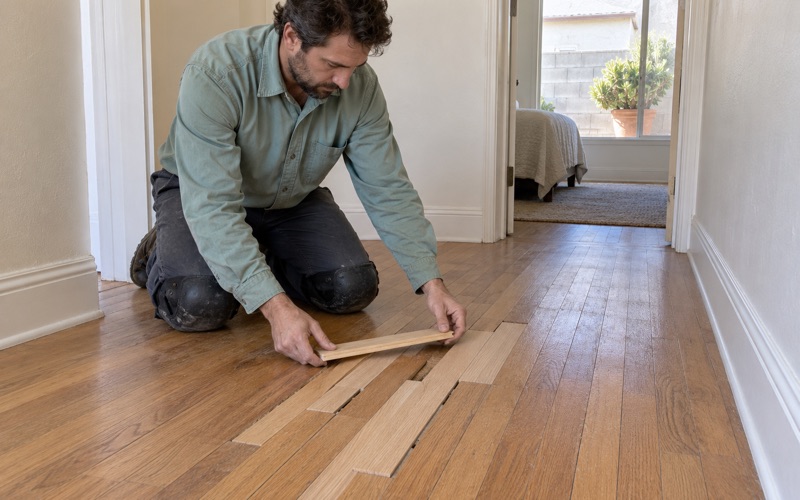
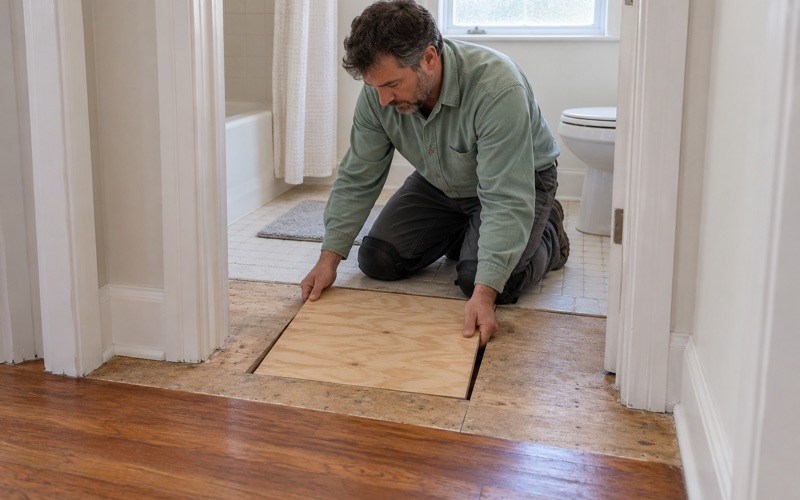
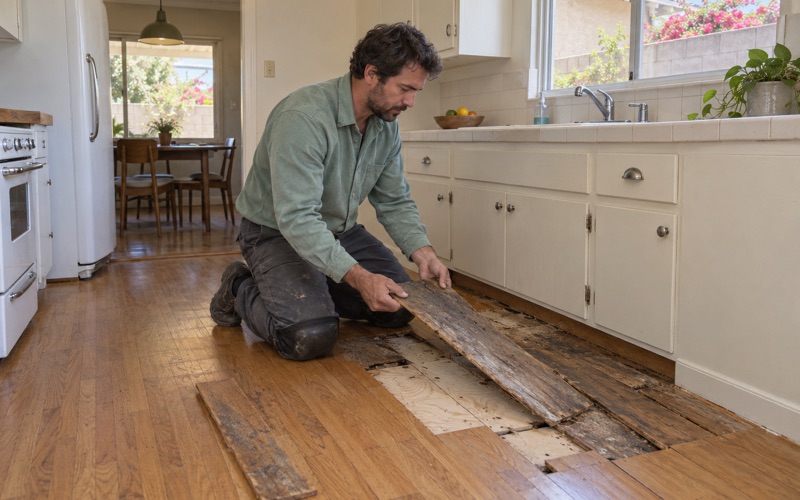
That 30-day window is when many owners call us. Floors that are split, lifting, soft underfoot or worn through to bare wood are the kind of condition an owner would rather correct before an inspector walks the unit. A board replacement, a weave-in repair where a section has failed, or tightening a squeaky area over a loose subfloor can often be completed inside that window if we are called early. Because we open and check the subfloor before pricing a finish floor, soft spots and water-swollen decking get found at the estimate rather than halfway through the job.
Floor Work, Old Layers and the Tenant Habitability Program
LAHD’s Tenant Habitability Program applies when an owner plans to renovate, repair or alter an RSO building and that work falls within the program. The program defines primary renovation as construction work on a major structural system, such as foundation, electrical, plumbing or mechanical, or the abatement of hazardous materials such as lead and asbestos.
When the program may come into play
Whether a floor project on its own counts as primary renovation is not something we answer, and we will not tell an owner their job is in or out. What we can say is that older floors often raise the hazardous-material question the program names. When that happens, the owner needs to take it to LAHD before work proceeds.
Where a Tenant Habitability Plan does apply, it must address noise, utility interruption, exposure to hazardous materials, interruption of fire safety systems, inaccessibility of all or part of each affected unit, and disruption of other tenant services. Our written schedule, containment plan and cure times are the kind of detail an owner needs to fill in those sections accurately.
Old tile, black mastic and asbestos questions
Pull up carpet or sheet vinyl in an older apartment and there is often another layer underneath. The one we stop for is old tile, especially the 9x9 asbestos floor tile common in mid-century buildings, and the black mastic adhesive that held it down. We treat either as a possible asbestos question before anything is sanded, scraped or ground. The next step is an asbestos survey by a qualified party, and any removal is handled under SCAQMD Rule 1403 by those qualified to do it, not by our crew.
This is also where the Tenant Habitability Program’s language about hazardous-material abatement becomes practical. If a survey finds asbestos in a layer that has to come out, the owner is dealing with abatement in an occupied building, and that is a conversation with LAHD before any flooring schedule is set.
Lead in pre-1978 buildings
The EPA Renovation, Repair and Painting rule covers pre-1978 housing, and much of the rental stock here predates that year. Flooring work disturbs baseboards, shoe molding, thresholds and door casings, all of which may carry old paint. We use lead-safe work practices on these buildings: plastic containment at doorways, careful removal of trim rather than prying it loose, and cleanup methods that keep dust out of the rest of the unit and the shared hallways.
Scheduling Floors Around Inspections and Tenants
An apartment floor rarely gets an empty week. Most jobs happen either in the short gap between tenancies or with someone still living in the unit, and each case needs a different plan.
Between tenancies
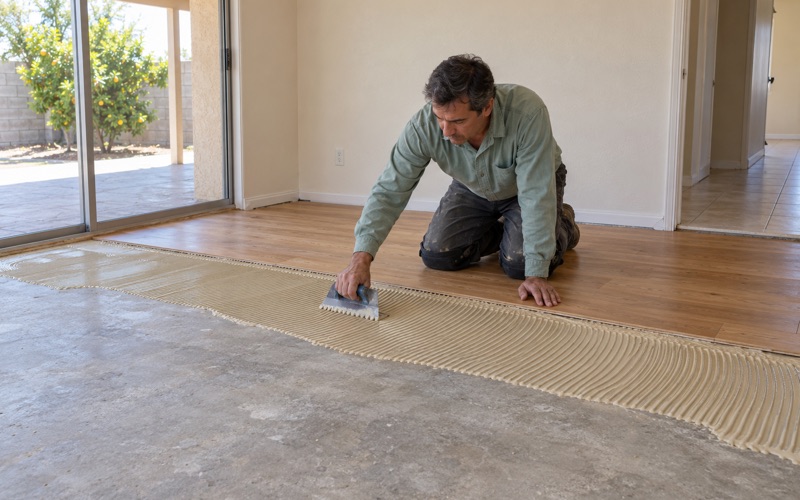
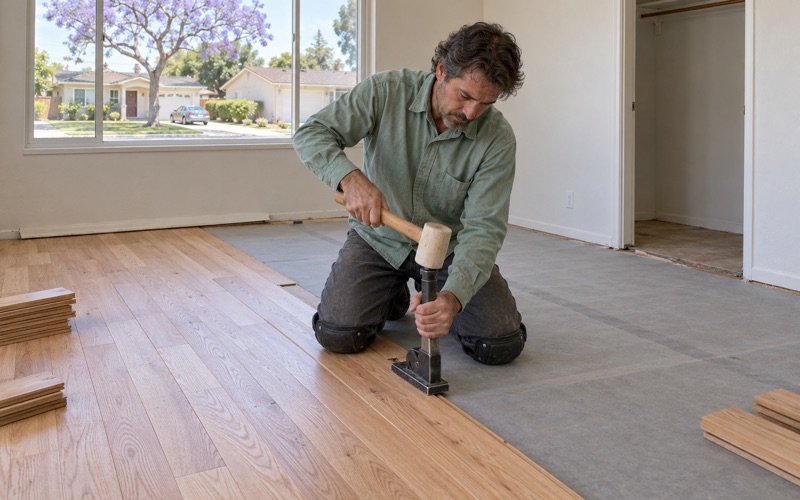
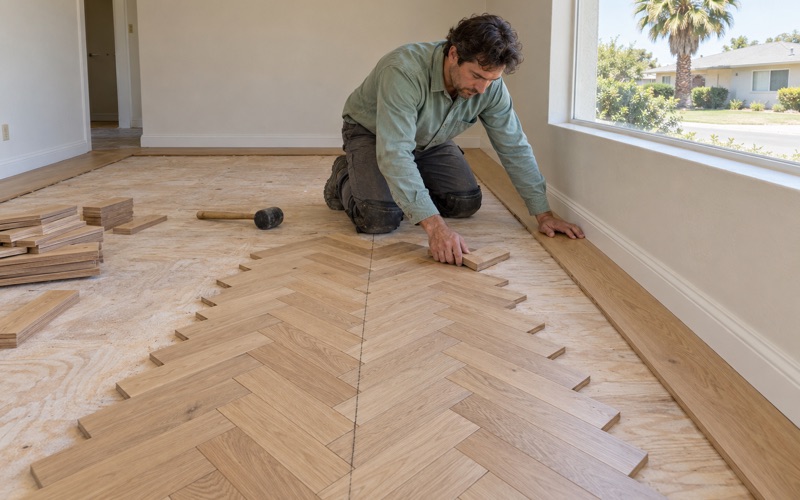
Turnover is the best window for sanding and refinishing, replacing damaged sections or installing new hardwood or engineered flooring. We measure moisture in the wood with a wood moisture meter and, where there is a concrete subfloor, test the slab before material is ordered, with the readings written down. New material is acclimated in the unit it will be installed in, with moisture content logged on arrival and again before installation.
For owners who need to account for damage at move-out, we provide written estimates and invoices itemized by area and task. California’s security deposit law, Civil Code 1950.5, requires itemized repair costs, and a flooring line that separates board replacement, refinishing and stair work is easier to use than a single lump sum. Stairs in two-story units are priced per tread and riser for the same reason.
With tenants in place
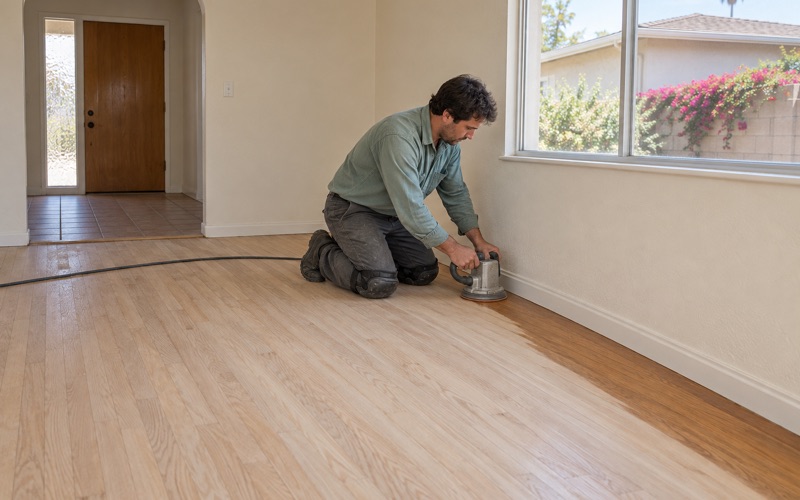
When a tenant is living in the unit, dust and timing matter more than anything else. We set up dust containment, use a dustless sanding system where the floor allows it, and work room by room when the layout lets us. Every occupied job comes with a written cure schedule so the tenant knows when each room can be walked on in socks, when furniture can go back, and when rugs can be laid down.
Finishes are chosen from products legal to apply in the South Coast air basin under the 275 g/L wood coatings VOC limit in SCAQMD Rule 1113. For occupied buildings we usually recommend waterborne polyurethane because it dries faster and carries less odor through shared walls and hallways than oil-modified options, though the final choice depends on traffic and the look the owner wants.
Planning around an inspection date
If a SCEP notice has arrived, tell us the inspection date when you call. We will look at what can realistically be finished and cured before then, flag anything that may need an asbestos or lead step first, and put the sequence in writing. Some repairs fit easily inside 30 days. A full refinish of several units with tenants in place may not, and it is better to know that at the estimate than on inspection day.
- 20+ Years on Wood Floors
- Moisture Readings in Writing
- Air-Basin-Compliant Finishes